August 25, 2026
·
12 min read
Autoblogging vs Manual Blogging: Which Scales SEO Safely?
A clear comparison of autoblogging vs manual blogging for sustainable SEO growth — evaluate risk categories, E‑E‑A‑T and quality guideline alignment, scaling mechanics, content quality controls, and technical SEO implications so you can choose a safe model (or hybrid) that fits your site.

If publishing more content automatically sounds like the fastest way to grow, you’re not alone—but scale can magnify mistakes as quickly as it multiplies pages. The real question isn’t “Can I publish more?” It’s “Will Google trust what I publish, and will users actually benefit from it?”
This comparison breaks down autoblogging and manual blogging in practical terms: where each model wins, where it breaks, and what “SEO safe” really means. You’ll get decision rules, workflow trade-offs, quality controls, and the technical guardrails that keep scaling from turning into spam.
Quick decision guide
Safe scaling means growth without tripping quality signals, brand risk, or index volatility. You’re optimizing for durable rankings, consistent crawl value, and content you can defend. Think fewer surprises, clearer ownership, and pages that earn trust over time.
Use autoblogging when
You use automation to cover breadth fast, so you need tight guardrails to avoid thin, repetitive pages.
- You cover long-tail niches at scale
- You publish from structured, verifiable sources
- You run a strong editing and QA pipeline
- You enforce strict review gates per template
- You keep brand risk extremely low
If you can’t review reliably, you’re not scaling content. You’re scaling liability.
Use manual when
Manual writing is slower, but it buys you precision where search intent and trust are fragile.
- You need subject-matter expertise on record
- You protect a reputation-sensitive brand
- You target nuanced intent and edge cases
- You create link-worthy original angles
- You publish opinions you must defend
When the cost of being wrong is high, speed stops being a feature.
Use hybrid when
Hybrid works when you want speed without surrendering credibility.
Use AI for outlines, first drafts, and variant exploration. Use humans for reporting, lived-experience details, strong editing, and final accountability. That combination keeps E-E-A-T signals real while still increasing throughput.
Treat AI like a junior writer. You still need an editor-in-chief.
Fast self-assessment
Answer these five questions with a blunt yes or no.
- Is this topic legally, medically, or financially risky?
- Do you need original reporting or firsthand experience?
- Can your budget support expert review and editing?
- Do you have editorial capacity for consistent QA?
- Can you tolerate indexing volatility or rewrites?
If you answered “yes” to risk and originality, go manual or hybrid. Automation is for low-stakes surfaces.
Define the two models
Autoblogging basics
Autoblogging is programmatic publishing driven by feeds, APIs, templates, and scheduled jobs. You use it to scale volume fast, with minimal human touch.
A common workflow looks like this: ingest a source (RSS, product API, database), map fields into a template, enrich with rules (categories, tags, internal links), then publish on a cadence. Tools range from CMS imports and Zapier-style automations to custom scrapers, templating engines, and scheduled scripts.
It breaks when inputs drift, templates flatten meaning, or you publish without editorial checks. The moment the source changes, your site can ship junk at scale.
Manual blogging basics
Manual blogging is human-led ideation, research, writing, and optimization, with deliberate accountability. You use it to control nuance, originality, and brand risk.
A typical workflow includes topic selection, SERP review, outlining, drafting, editing, adding visuals, on-page optimization, and a pre-publish QA pass. Quality controls often include source checks, uniqueness checks, internal linking review, and a final approval from someone responsible.
It scales slower, but it fails slower too. That trade is why many teams keep manual review on anything that can hurt trust.
Gray-area variants
Most real-world setups land between pure automation and fully manual work. These variants differ by how much human judgment touches the final page.
- AI-assisted drafts, human edits
- Curated aggregation with commentary
- Translation with localization review
- Programmatic SEO pages from databases
The dividing line is oversight on usefulness and accuracy, not the tool used.
Workflow comparison
Both models run through the same lifecycle, but they place checkpoints in different spots.
- Choose topics: keyword research vs feed-driven selection.
- Create content: write and edit vs template and generate.
- Validate quality: editorial QA vs rules plus spot checks.
- Publish and link: manual internal linking vs automated linking logic.
- Refresh and prune: periodic audits vs automated updates with monitoring.
Add checkpoints where failure is expensive: facts, intent match, and duplication. Automate production, not responsibility.
What “SEO safe” means
SEO safe is predictability under real search conditions. Your pages get indexed, your rankings don’t whipsaw, and updates don’t nuke whole sections.
Safety also means alignment with quality guidelines. You avoid patterns that erode sitewide trust, even if a few pages perform. In practice, that often comes down to having a repeatable content system with consistent on-page hygiene (keywords, meta descriptions, formatting) and an editorial check—whether you write manually or use an AI workflow like Skribra to standardize those basics (see this SEO guide for best practices).
Core risk categories
Safety breaks when you trip repeatable failure modes. Autoblogging and manual blogging can both fail, but the blast radius differs.
- Thin or duplicate content at scale
- Scaled content abuse patterns
- Misinformation and unverified claims
- Spam signals from templated footprints
- Sitewide quality dampening
One weak post is a problem. A weak system is a penalty-shaped event.
This is why tooling matters less than governance: if your platform encourages unique angles, proper structure, and avoids cookie-cutter templates (and you actually review what gets published), you reduce the “repeatable failure mode” risk that gets sites into trouble.

E-E-A-T realities
E-E-A-T is less a score and more a set of proofs. Humans supply the receipts: firsthand detail, accountable authorship, and consistent editorial intent.
Automation struggles when the proof must be inherent in the content. “Sounds right” isn’t the same as “I did it, here’s what happened.”
If you can’t show your work, you’re betting your domain on vibes.
If you use AI to scale drafts, the safer pattern is: let the system handle SEO hygiene and structure, then have a real person add the experiential details, sources, and accountability. That division of labor is typically easier when your workflow supports consistent formatting and publishing—rather than ad-hoc copy/paste processes.
Indexing volatility
Mass publishing changes how search engines allocate crawl attention. You can get indexed fast, then quietly deprioritized when quality looks noisy.
Watch for early warnings in Search Console:
- Crawled, not indexed rising
- Discovered, not indexed rising
- Soft 404s on thin pages
- Crawl stats shifting to low-value URLs
Indexing is a resource negotiation. Don’t give crawlers reasons to walk away.
If you’re publishing daily via WordPress integrations (whether native or through platforms like Skribra), you need tighter controls around what goes live: fewer low-value pages, clearer intent targeting, and periodic pruning, so your crawl budget isn’t diluted by marginal URLs.
Quality guideline alignment
Treat safety like a reviewer checklist, not a publishing quota.
- Confirm the page satisfies a specific user intent.
- Add original value beyond obvious summaries.
- Disclose automation and editorial review where relevant.
- Improve helpfulness with examples, limits, and next steps.
- Remove or rewrite pages you can’t stand behind.
Write for the evaluator you’ll never meet. They decide whether your whole site feels trustworthy.
A practical advantage of a structured content platform is consistency: it’s easier to enforce intent-first briefs, require meta descriptions and clean formatting, and maintain an audit trail of what was reviewed before publishing. Those operational details don’t guarantee “SEO safety,” but they make it easier to stay aligned with the guidelines that actually drive it.
Scaling mechanics
Both autoblogging and manual blogging can scale, but they scale different constraints. One hits quality control and maintenance. The other hits human throughput and coordination.
You can compare the scaling tradeoffs cleanly across velocity, cost, bottlenecks, and long-term burden.
| Scaling factor | Autoblogging | Manual blogging | What breaks first |
|---|---|---|---|
| Content velocity | High, easy ramp | Moderate, planned ramp | Review capacity |
| Cost per post | Low, predictable | Higher, variable | Budget focus |
| Bottlenecks | QA, indexing, abuse | SMEs, editing, briefs | Human attention |
| Maintenance burden | High, many pages | Lower, fewer pages | Content decay |
| Control and consistency | Template-driven | Voice-driven | Brand drift |
The winner is the one whose failure mode you can monitor and fix every week.
Content quality controls
Scaling content safely needs a quality system, not a “better writer” promise. You want minimum safeguards that work for humans and machines.
Minimum safeguards:
- A pre-publish gate that blocks weak pages
- A defined sourcing rule for every factual claim
- A originality plan beyond paraphrasing
- A spam-pattern check for automation signals
- A correction process with visible accountability
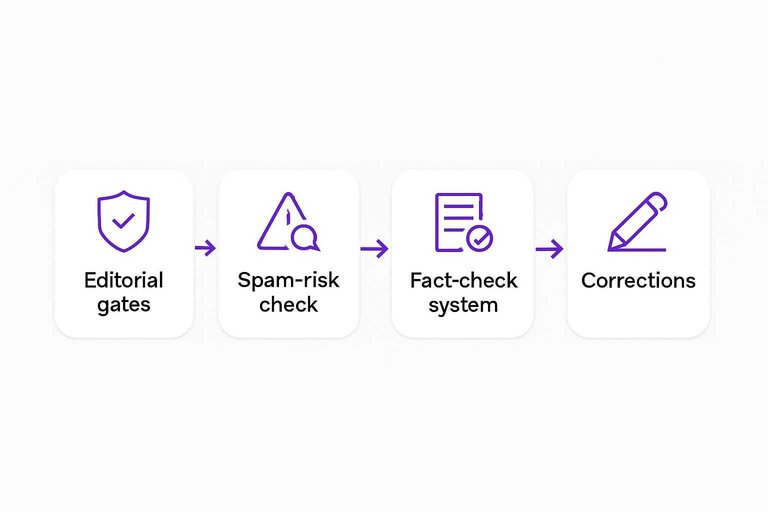
Non-negotiable for autoblogging: hard editorial gates, spam-risk detection, and a fact-check workflow that can stop publishing—use an essential AI content checklist to standardize what “pass” looks like. If the system can’t say “no,” it will eventually ship junk.
Editorial gates
You need repeatable checks that catch errors before indexing. The goal is boring consistency at scale.
- Confirm search intent matches the query and page angle.
- Verify originality beyond rewording, including unique inputs.
- Check factual claims against approved sources and add citations.
- Validate internal links, anchors, and destination relevance.
- Run template sanity checks for layout, metadata, and boilerplate.
Autoblogging needs these as enforced blockers, not “review later” suggestions.
Originality sources
You can’t scale trust by remixing the same SERP inputs. Add uniqueness with inputs competitors can’t copy instantly.
- Run first-hand tests, even lightweight, and document results.
- Collect expert quotes with clear attribution and context.
- Publish proprietary frameworks, checklists, or scoring rubrics.
- Add updated context like policy, pricing, or platform changes.
If your uniqueness depends on phrasing, it won’t survive the next content wave.
Spam-risk red flags
Some patterns scream “machine output,” even when the facts are fine. You want to detect those patterns before Google does.
- Repetitive intros that re-state the keyword every time.
- Templated headings that mirror page after page.
- Near-duplicate pages targeting minor keyword variants.
- Over-optimized anchors repeating exact-match phrases.
When these stack up on one URL cluster, you’re building a footprint, not a brand.
Fact-check system
You need a clear chain of responsibility for claims, especially at scale. Without roles and source rules, “accuracy” becomes vibes.
Roles and workflow:
- Author: adds sources per claim and flags uncertainty.
- Editor: checks intent, structure, and citation completeness.
- Fact-checker or SME: verifies key claims and terminology.
Sources hierarchy:
- Primary sources first, like standards, documentation, and official statements.
- Credible secondary sources next, with transparent publication context.
- Tertiary sources last, only for background framing.
YMYL handling:
- Require human review before publish.
- Avoid prescriptive advice when you aren’t qualified.
- Add clear scope notes and update triggers.
Corrections:
- Maintain a change log with date, what changed, and why.
- Fix quietly for typos, but log substantive claim changes.
- Add a correction note when readers could be misled.
Autoblogging can scale words fast, but it must scale accountability faster.
Best-fit scenarios
Autoblogging fit
Use autoblogging when your pages are mostly structured data, and your risk is missing coverage. Think catalogs, inventories, and directories where the “truth” lives in a database.
A good fit looks like: product and variant pages, event schedules, job listings, location pages, and templated FAQs pulled from verified fields. Add light editorial rules, like canonical handling and duplicate suppression, then publish at scale. You’re scaling completeness, not opinions.
Manual fit
Use manual blogging when the value comes from judgment, synthesis, and voice. That’s where generic text becomes a liability fast.
Best fits include opinionated guides, investigative pieces, original frameworks, and nuanced comparisons with tradeoffs and edge cases. Manual work also shines when sources conflict, terminology is messy, or your audience needs reassurance and context. You’re scaling trust, not just pages.
Hybrid fit
Use hybrid when you need speed and coverage, but you can’t afford unchecked output.
- Use templates for repeatable sections, then add human context.
- Use automation for refreshes, then review changes before publishing.
- Use AI drafts for long-tail clusters, then edit for intent match.
- Use feeds for briefs, then add sourcing and attribution.
Hybrid works because you automate the boring parts, not the accountability.
Avoid altogether when
Avoid scaling when you can’t verify claims or enforce review.
- Stop if content affects money, health, or safety without expert review.
- Stop if your inputs are scraped, unstable, or impossible to audit.
- Stop if you can’t cite sources or keep provenance per page.
- Stop if you can’t monitor quality drift after publishing.
If you can’t prove it, don’t scale it.
Technical SEO implications
Autoblogging can scale pages faster than your site can crawl, understand, and trust. Manual blogging scales slower, but it usually keeps signals cleaner. The safe path is whichever method keeps indexation tight, duplication low, and templates honest.
Crawl and index
Fast publishing can look like growth, then turn into an index full of thin URLs. Pace output so discovery stays high and low-value pages stay out.
- Publish in batches, then wait for crawl signals to stabilize.
- Submit clean XML sitemaps segmented by content type.
- Add new URLs to hubs first, not orphaned pagination.
- Noindex tag pages, internal search, and low-intent archives.
- Prune or consolidate URLs that never earn impressions.
If Google keeps recrawling junk, your best pages pay the bill.
Duplication control
Autoblogging increases the chance of near-duplicate pages from shared templates, repeated angles, and syndicated inputs. Your job is to choose one winner URL and suppress the rest.
- Set canonicals to the primary version.
- Block parameter crawl with Search Console rules.
- Vary templates beyond swapped keywords.
- Use unique titles and lead paragraphs.
- Detect feed scraping and DMCA fast.
If two pages answer the same query, Google will pick for you.
Internal linking
Scaling posts without a linking plan creates orphaned pages and noisy anchor patterns. Build hubs manually, then automate links inside guardrails.
Imagine a hub page for “email deliverability” with spokes for SPF, DKIM, and bounce handling. Use rules like “link first mention to the hub,” and cap repeated anchors per page. Keep anchors descriptive, not keyword-stuffed, and avoid sitewide blocks that fire everywhere.
Link rules should look like editing, not like a plugin got excited.
Structured data hygiene
Automation makes schema easy to stamp across thousands of URLs. It also makes it easy to contradict your own page.
Only mark up what users can see, and keep fields consistent with the actual template. Don’t label every post as a Product, Review, or FAQ if it’s really a generic article. Validate after template changes, because one bad deploy can replicate spammy markup sitewide.
Schema scales trust when it matches reality, and penalties when it doesn’t.
Choose a Scaling Model You Can Defend (and Maintain)
- Pick your default mode: autoblogging for structured, low-ambiguity topics; manual for expertise-led or high-stakes content; hybrid when automation can draft but humans must validate.
- Define “SEO safe” for your site: set minimum standards for usefulness, originality sources, author accountability, and how you’ll handle updates and corrections.
- Install editorial gates: require fact-checking, duplication checks, link and citation review, and clear spam red flags that trigger rejection.
- Protect crawl and index health: control templates, canonicalization, internal linking, and structured data so scaled publishing doesn’t create thin, duplicate, or orphaned URLs.
- Start small, then expand: ship a limited batch, monitor indexing/engagement signals and quality outcomes, and only scale the workflow that consistently clears your standards.
Frequently Asked Questions
- Can autoblogging get my site a manual action or deindexing in 2026?
- Yes, it can if autoblogging produces unoriginal, thin, or mass-duplicated pages at scale. Risk usually comes from patterns (near-identical templates, low-value pages, programmatic spam signals), not from automation itself.
- How do I audit an autoblog for quality and SEO risk before scaling up?
- Start with Google Search Console (Indexing + Manual Actions) and a crawl in Screaming Frog or Sitebulb to spot duplicates, thin pages, broken canonicals, and orphan URLs. Then manually review a sample of posts for accuracy, originality, and intent match, and prune/merge anything that fails.
- Should I noindex autoblogged posts until they’re reviewed?
- Often yes for new sites or new topics—publish in a staged workflow (draft or noindex), QA the content, then switch to index when it meets your standards. This helps avoid flooding Google with low-confidence pages that can drag down overall trust.
- What’s the safest way to do a hybrid approach (autoblogging + manual blogging) without confusing Google?
- Use automation for standardized sections (outlines, FAQs, metadata drafts) and keep humans responsible for final claims, unique insights, and internal links, with one consistent on-page template. Maintain clear topic clusters and avoid publishing multiple near-identical pages targeting the same query.
- What autoblogging tools work best for WordPress when I need human review and controlled publishing?
- Look for platforms that support WordPress integration plus draft mode, editorial review steps, and structured metadata outputs; Skribra can fit if you want AI drafting with WordPress publishing while keeping a human approval gate. Prioritize tools that let you control templates, categories/tags, and publishing cadence so quality checks stay enforceable.
Scale Autoblogging With Guardrails
Choosing between autoblogging and manual blogging is easier than maintaining quality, technical SEO, and consistency as you publish at scale.
Skribra helps you scale SEO-safe autoblogging with keyworded briefs, structured formatting, WordPress publishing, and built-in quality controls—plus a 3-Day Free Trial to validate results fast.
Written by
Skribra
This article was crafted with AI-powered content generation. Skribra creates SEO-optimized articles that rank.
Share: