August 8, 2026
·
10 min read
9 Enterprise SEO Limitations Worth Knowing in 2026
A practical collection of enterprise SEO limitations to watch in 2026—clarify what “enterprise” really buys you, anticipate data and implementation bottlenecks, spot tooling overlap and governance friction, and adapt measurement for international and AI-driven search volatility.

Enterprise SEO promises scale: more pages shipped, more markets covered, more reporting, more leverage. Then reality hits—numbers don’t match across tools, tickets stall in backlogs, and “global” rollouts break on local edge cases.
This collection walks you through the most common enterprise SEO limitations worth planning for in 2026, so you can set expectations early, validate the right data, negotiate workable governance, and choose measurement that still holds up as AI changes where visibility shows up.
What “Enterprise” Means
Enterprise SEO in 2026 is SEO run as an operating system, not a set of tactics. You buy it when your site and org structure create coordination problems that individuals cannot brute-force.
Imagine a company with six brands, three CMSs, and weekly releases. Everyone is “doing SEO,” yet rankings still drift because decisions are disconnected.
Enterprise tooling and programs can close that gap, but only if your expectations match your constraints.
Typical buying triggers
Enterprise SEO usually gets budget when risk or complexity spikes. The purchase is often a control move, not a growth move.
- Platform or domain migrations
- Multi-brand and multi-site sprawl
- International expansion and localization
- Legal, privacy, or accessibility compliance
- Executive demand for predictable reporting
If two or more triggers hit at once, you’re buying coordination, not keywords.
What it promises
On paper, enterprise SEO promises repeatability at scale. You expect fewer surprises, faster decisions, and cleaner handoffs.
The core wins look like governance for templates and metadata, automation for audits and monitoring, and visibility across teams. Collaboration improves when tickets, priorities, and outcomes live in one shared workflow.
The real promise is fewer “we didn’t know” moments.
Where it breaks first
Breakage shows up when the org can’t absorb the system it bought. Tools amplify whatever is already messy.
- Low trust in dashboards and data sources
- Misaligned goals across SEO, brand, and product
- Workflow friction with dev and content teams
- Over-tooling without clear operating rules
- Unclear ownership for fixes and outcomes
Fix the system first. Then the tool starts working.
Viability lens
Enterprise SEO fits when your organization can convert insights into shipped changes. Otherwise, you’re paying for reports that age in a week.
Look for baseline maturity in prioritization, a steady content and template cadence, enough dev capacity for recurring technical work, and realistic risk tolerance for automation. Also check procurement constraints like security reviews, vendor lock-in concerns, and data residency requirements.
If shipping is slow, buy process before platform.
Limitation 1: Data Disagreements
“Single source of truth” breaks in enterprise SEO because your inputs disagree by design. Sampling, attribution variance, crawler gaps, and reporting politics turn one dashboard into many truths. If two teams are paid to defend different numbers, alignment gets political fast.
Common mismatch sources
Enterprise SEO data drifts because each system observes a different reality. Some tools infer; others measure; some do both poorly.
- Index volatility and delayed recrawls
- Personalization and geo-local SERPs
- Log files versus crawler snapshots
- Canonicalization and duplicate clustering
- Vendor methodologies and black boxes
If three tools disagree, trust the pattern, not the point value.
What to validate
Validate the decision inputs, not the vanity totals.
- Check trend consistency across sources, not absolute numbers.
- Run segment sanity checks by directory, template, and device.
- Spot-verify key SERPs manually for critical queries.
- Triangulate with log files to confirm real bot behavior.
When your checks disagree, slow the decision down, not the analysis.
Decision impact
Bad data warps prioritization because it rewards what looks urgent, not what is urgent. You end up chasing phantom drops, over-investing in the wrong templates, or declaring wins that never happened. Stakeholders stop trusting SEO when the story changes every meeting. (See Google’s explanation of why Search Console and Analytics often disagree.)
Limitation 2: Slow Implementation
Enterprise SEO rarely fails on ideas. It fails on throughput.
Your recommendations compete with engineering queues, change windows, and risk reviews. Even “small” SEO changes touch systems built to prevent surprises.
Where time goes
Most delays are process delays, not technical difficulty.
- Ticket grooming and re-scoping
- QA cycles across environments
- Release trains and code freezes
- Security reviews and threat modeling
- Legal approvals and stakeholder sign-off
Speed comes from removing handoffs, not writing better tickets.

Mitigation patterns
You need a playbook that reduces risk, then reduces waiting.
- Ship pre-approved templates for titles, canonicals, schema, and robots.
- Build SEO-safe components engineers can reuse without reviews.
- Batch the backlog into quarterly “SEO trains” with clear scopes.
- Set SLAs by impact level, tied to release planning.
- Define escalation paths when deadlines slip or risk is misclassified.
If SEO depends on heroics, it will lose to the next incident—and investing in tools to supercharge content workflows can help reduce handoffs and waiting time across teams.
When it’s a dealbreaker
Slow is normal. Stuck is fatal.
If critical fixes miss seasonal or regulatory windows more than once, your program becomes reactive. If core templates have no owner, every fix becomes a bespoke project.
Limitation 3: Tooling Overlap
Enterprise stacks grow by acquisition, urgency, and good intentions. Then you inherit duplicated work, competing alerts, and integrations held together by hope.
When three platforms claim to be “the source of truth,” teams stop trusting all of them. You ship slower. You argue more.
Overlap hotspots
Tool overlap shows up where tools promise speed and certainty. Those are also the places where duplication quietly multiplies.
- Rank tracking across multiple vendors
- Crawling with different rules and schedules
- Dashboards built on conflicting metrics
- Content briefs generated in parallel
- Link monitoring with separate alerts
- QA automation that overlaps checks
If two tools watch the same thing, one becomes noise or politics.
Consolidation approach
Consolidation works when you treat tools like infrastructure, not preferences. You are choosing reliability, not features.
- Map each tool to a clear job-to-be-done.
- Pick one system of record per data type.
- Retire tools that duplicate that record.
- Document workflows, owners, and handoffs.
Keep the best tool only after you pick the best truth.
Hidden costs
Overlap doesn’t just cost licenses. It costs attention, access risk, and operational brittleness.
Training never ends because every team learns a different UI and model. Permissions sprawl, and offboarding becomes a scavenger hunt.
Connectors fail quietly, vendor roadmaps drift, and audit trails fracture across systems. The stack still “works,” until it matters most—especially when you need clean, centralized monitoring like the Search Console Crawl Stats report during incident response.
Limitation 4: Governance Friction
Enterprise SEO rarely fails on ideas. It fails on rules.
Brand, legal, accessibility, and security controls protect the company. They also slow experiments, narrow options, and turn simple changes into calendar events.
Governance pain points
Governance friction shows up as small “no” decisions that pile up fast. The result is slower shipping, fewer tests, and safer-but-blander pages.
- Copy approvals across multiple teams
- UI component restrictions from design systems
- Cookie and consent policy constraints
- Localization standards and translation workflows
- Regulated claims and disclaimer rules
If three teams can veto a title tag, you don’t have an SEO problem. You have a throughput problem.
What to negotiate
You won’t win by asking for “more flexibility.” You win by proposing guardrails that reduce review load and risk.
A practical deal often includes pre-approved SEO patterns, like title formulas and internal link modules, plus controlled tests with clear stop conditions. Add documented exceptions and compliance-friendly wording options, so approvals become selection, not debate.
Negotiate for defaults, not one-off approvals. Defaults scale.
Operationalizing approvals
Speed comes from turning approvals into a repeatable system. Do that once, then reuse it everywhere.
- Define owners for brand, legal, accessibility, and security reviews.
- Create checklists for common SEO changes and page types.
- Automate checks where possible, like linting and CI gates.
- Shorten review cycles with set SLAs and office hours.
- Record decisions in a searchable log with examples.
When governance becomes a workflow, experimentation stops feeling like a special request.
Limitation 5: Content at Scale
Publishing more pages can make your site worse, not better. At enterprise scale, the constraint stops being ideas and becomes control: intent, freshness, and link flow. Imagine a catalog that doubles, but half the pages answer the same question.
Scale failure modes
Scale breaks in predictable ways, and they compound fast. You need to spot the patterns, not just the symptoms.
- Thin templated pages with no unique value
- Duplicate intent across near-identical URLs
- Stale catalogs that never get refreshed
- Parameter sprawl creating endless variants
- Internal link chaos from uncontrolled growth
If you see three or more, you’re looking at a system problem, not a content problem.
Maintenance reality
At scale, content is an asset only if someone owns its lifecycle. Refresh cycles, pruning, and clear ownership usually beat net-new volume, because they prevent decay from spreading.
Your roadmap should treat updates like product maintenance, not editorial “nice-to-haves.” For a structured approach, use an SEO content streamlining checklist to standardize refresh and pruning decisions.
Quality control workflow
You need a workflow that makes quality the default, even when output grows. The goal is fewer surprises and fewer orphaned decisions.
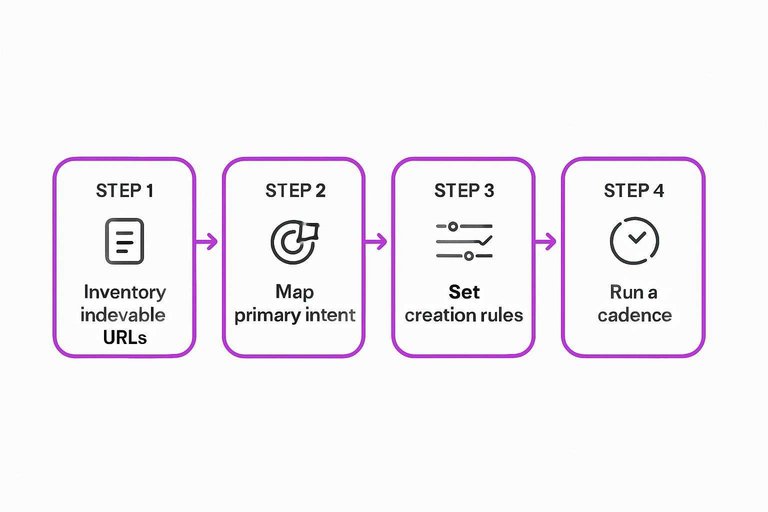
- Inventory every indexable URL and its purpose.
- Map each page to one primary intent and one canonical target.
- Set creation rules: thresholds for uniqueness, depth, and internal links.
- Monitor decay signals: impressions drop, outdated facts, SERP intent shifts.
- Run a cadence: update winners, merge duplicates, prune dead weight.
The workflow is the strategy, because it decides what gets to exist.
Limitation 6: International Complexity
International SEO stops being “apply hreflang and move on” the moment you have real markets. Region SERPs, localization choices, and shared infrastructure create coordination overhead and weird edge cases.
Common international traps
International issues rarely come from one big mistake. They come from small mismatches that compound across markets.
- Hreflang loops and self-references missing
- Mixed languages on one URL
- Geo proxies masking real content
- Shared templates leaking wrong copy
- Inconsistent taxonomy across regions
If two teams can change one template, you can create five countries of bugs overnight.
What to test
Treat international SEO like QA, not a one-time config.
- Run locale SERP checks from target countries.
- Audit URL-to-locale mappings for gaps and duplicates.
- Sample logs by region and compare bot behavior.
- Check template parity across locales and devices.
If you can’t reproduce the experience by market, you can’t reliably fix it.
Coordination bottleneck
International pages touch more calendars than code. Translators, local marketing, legal, and dev teams ship on different cycles.
One market might finalize claims late, another might change product naming, and legal might block a term entirely. Meanwhile, engineering deploys a shared component that rewrites titles everywhere.
Your real constraint becomes coordination latency, not crawl budget.
Limitation 7: AI Search Volatility
AI overviews and answer engines can satisfy intent without a click. That breaks the old loop: rank goes up, sessions go up. Your keyword KPIs get noisier, even when your content is improving.
Where SEO loses visibility
AI results change the shape of the SERP, not just the order of links. That reduces what you can reliably observe in classic reporting.
- More zero-click answers
- More blended SERP modules
- More unclear source attribution
- More brand vs non-brand skew
- More query rewriting upstream
Treat “ranking” as a partial signal, not the scoreboard.
What to measure instead
When clicks get rationed, you need signals that survive the interface. You’re measuring demand capture and influence, not just visits.
Track a mix of: demand capture (qualified leads and pipeline touchpoints), brand lift proxies (direct traffic, branded queries, navigation searches), assisted conversions (multi-touch paths), share-of-voice across priority topics, and entity coverage (how often your brand is referenced, cited, or selected).
If AI is the new front door, your job is to become the default room it points to.
Practical adaptation steps
Plan for volatility as the baseline, not the exception.
- Prioritize defensible pages that own a decision, not just an answer.
- Strengthen entities with consistent names, relationships, and about pages.
- Improve structured data to reduce ambiguity in extraction and attribution.
- Diversify channels so search changes don’t zero your demand.
Build resilience first; then chase incremental rank.
Plan Around the Limitations Before They Plan Around You
- Run a pre-mortem: pick the 2–3 limitations most likely to hit your org (data, speed, governance, scale, international, AI volatility) and write the failure scenario in plain language.
- Convert each scenario into a control: a validation checklist for metrics, a defined implementation lane with SLAs, a consolidation map for overlapping tools, and an approval workflow that names owners and timelines.
- Reframe reporting: track outcomes at the page, market, and template level—and add visibility proxies that still matter when AI answers reduce classic SERP clicks.
- Review quarterly: revisit the limitations after major launches, re-orgs, or platform changes, and update your operating model before the next bottleneck becomes “normal.”
Scale Enterprise Content Execution
Enterprise SEO breaks down when content at scale collides with slow implementation, governance friction, and constant AI search volatility across teams and markets.
Skribra helps enterprise teams publish SEO-optimized articles consistently with WordPress integration, automated formatting, and built-in backlink exchange—start with the 3-Day Free Trial.
Written by
Skribra
This article was crafted with AI-powered content generation. Skribra creates SEO-optimized articles that rank.
Share: