August 3, 2026
·
11 min read
How Enterprise SEO Works: Advanced Governance and Scale
An explainer on how enterprise SEO actually works when governance and scale define success—decision rights and RACI design, policy-as-code guardrails, inventory-led prioritization, technical crawl/indexation controls, and content ops workflows that keep thousands of pages aligned.

If your SEO roadmap keeps getting derailed by legal reviews, platform constraints, and five different teams shipping changes, the problem isn’t a missing tactic—it’s missing governance.
Enterprise SEO is a system: you need clear decision rights, enforceable guardrails, and a way to prioritize changes across a massive URL inventory. This explainer breaks down how the operating model works in practice, from RACI and escalation paths to crawl/indexation controls and a content engine that scales without turning quality into an afterthought.
Enterprise SEO Reality
Enterprise SEO is less about clever tactics and more about governance across many teams, systems, and risks. You’re shaping policies, choosing platforms, and making execution repeatable at scale.
System, not tactics
Enterprise SEO is an operating model, because hundreds of releases will outpace any one expert’s judgment. Your job is to define decision rights, standards, and pipelines that survive turnover.
A useful operating model usually includes:
- Clear owners for templates, content types, and key technical systems
- Written standards for URLs, metadata, internal linking, and structured data
- Intake and triage for SEO requests, with predictable SLAs
- Repeatable QA for every release, not hero debugging
If SEO only lives in tickets, it dies in prioritization.
Constraints that matter
At enterprise scale, constraints shape what’s possible more than best practices do. You plan around them, or you burn cycles.
- Legal and compliance reviews gate many changes
- Brand control limits copy and layout flexibility
- Multi-market needs create translation and hreflang complexity
- Platform fragmentation splits ownership across stacks
- Release cadences delay fixes and compound risk
Treat constraints like product requirements, not annoying exceptions.
Where it breaks
Enterprise SEO breaks when teams optimize locally and the system pays the bill. One group improves a page, while another ships a template that quietly undoes it.
You’ll see the same patterns: conflicting KPIs, duplicate tools, and technical debt with no owner. That’s the line that gets crossed.
Fix the ownership map, then fix the site.
Mental model preview
You need a simple shared model, because complexity makes people default to opinions. A clean frame aligns teams fast.
Think in four parts:
- Inputs: inventory of pages, templates, markets, and systems
- Controls: governance, standards, and approvals
- Engines: workflows that ship changes safely
- Feedback: measurement that detects drift and impact
When inputs and feedback stay current, governance becomes leverage instead of bureaucracy.
Governance Architecture
Enterprise SEO fails when nobody knows who decides, and nobody can enforce. Governance fixes that with explicit ownership, enforceable policies, and fast escalation paths.
Treat SEO like a production system, not a set of suggestions—use a practical enterprise SEO guide to align teams on what must be enforced. Optional rules become broken templates.
Decision rights map
You need a decision map so teams can ship without guessing, and so disputes end quickly. Put the most common SEO artifacts in one table.
| SEO artifact | Owner (decides) | Executor (implements) | Escalation if blocked |
|---|---|---|---|
| Templates | Web platform | Feature teams | Platform council |
| Content rules | Editorial | Writers | Content governance |
| Redirects | Platform + SEO | Ops | Incident lead |
| Canonicals, hreflang | SEO | Platform | SEO director |
| Internal links, deprecations | SEO + Product | Platform | Product council |
If you cannot name an owner, you have a future outage.
RACI that works
A RACI only helps when it’s tied to real artifacts and real deadlines. Build it from the work you actually ship.
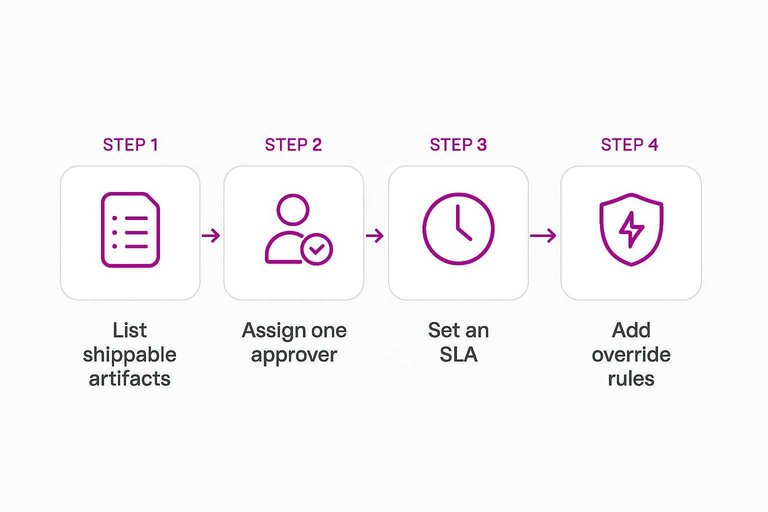
- List shippable artifacts, like templates, sitemaps, and redirect rules.
- Assign one approver per artifact, not a committee.
- Set an SLA for review, with a default outcome.
- Add override rules for incidents and launch windows.
Without an SLA and override, your RACI becomes a polite backlog.
Policy as code
PDF policies rot because they cannot fail a build. Encode SEO rules where work happens: CI/CD, the CMS, and automated checks.
Examples that scale:
- CI checks that block missing canonicals.
- CMS validations for title length and indexability flags.
- Linters for hreflang parity across locales.
- Scheduled crawls that open tickets on regressions.
If your policy can’t stop a bad deploy, it’s documentation, not governance.
Escalation pathways
Escalation prevents “we’ll fix it later” from becoming permanent. Define the triggers so teams escalate early, not after rankings drop.
- Traffic-risk releases without SEO review.
- Legal conflicts over copy, claims, or disclosures.
- Indexing incidents like noindex, robots, or canonical flips.
- Cross-market collisions in hreflang or duplicate content.
Escalation is a feature, not a failure.
Exceptions handling
Exceptions will happen, so make them safe and temporary. Treat every exception like debt with interest.
- Time-box the exception with an expiry date.
- Document the rationale and the accepting owner.
- Add monitoring, alerts, and a rollback plan.
- Schedule removal work in a real sprint.
If exceptions don’t expire, they become the new policy.
Scale Through Inventory
Enterprise SEO scales when you know what you own. A unified URL and template inventory keeps you working where changes compound, not where noise is highest.
Imagine two requests: “fix this page” versus “fix the template behind 40,000 pages.” One is busywork. The other is leverage.
URL universe stitching
You need one reconciled URL universe so every team argues from the same map. Without it, duplicates win meetings.
- Export URLs from sitemaps, crawl data, analytics, and Search Console exports.
- Add server logs to capture ignored, orphaned, and bot-favored URLs.
- Canonicalize variants by rules: parameters, trailing slashes, casing, and hostnames.
- Cluster duplicates using canonicals, redirects, and near-identical templates.
- Store each URL with attributes: template, status, market, and indexability.
If you can’t reconcile variants, you can’t prioritize outcomes. For canonicalization guardrails, follow Google’s guidance on consolidating duplicate URLs.
Template taxonomy
Templates are your real “pages” at enterprise scale. A clear taxonomy turns SEO from whack-a-mole into governance.
Define template classes like PLP, PDP, category hub, store locator, help article, and internal search. For each class, specify invariants: global navigation patterns, H1 rules, allowed heading structure, required structured data, and mandatory content blocks.
Once invariants exist, QA becomes a checklist, not an argument.
Prioritization signals
Prioritization needs shared signals, not loud requests. Your inventory lets you score work by compounding impact.
- Template reach across many URLs
- Index coverage gaps by segment
- Crawl demand from logs
- Revenue adjacency to core funnels
- Cannibalization risk within clusters
When signals disagree, pick the one that prevents irreversible damage first.
Change surface area
Page-level edits feel safe, but they rarely move the system. Template-level changes reshape thousands of pages with one deployment.
Quantify reach with affected URLs, markets, and device variants tied to that template. Then measure the blast radius too: internal links, schema, titles, and indexability rules often ride along.
If you can’t describe the surface area, you’re not ready to ship the change.
Technical SEO at Scale
Enterprise technical SEO breaks when one rule meets ten platforms. Add multiple CDNs, shared components, and partial ownership, and small mistakes multiply fast.
Your job is to make crawling and indexing boring again. Predictable inputs. Predictable outputs. That often means pairing governance with systems that publish consistently structured pages—especially if you’re producing content at volume through tools like Skribra, where templates, metadata, and formatting can be standardized before anything goes live.
Crawl budget levers
Reduce crawl waste before you ask for more crawl. You want bots spending time on pages that can rank.
- Set parameter rules: block or rewrite non-canonical tracking and sort parameters.
- Control faceted navigation: allow only index-worthy facet combinations.
- Prune internal links: remove infinite calendars, tag clouds, and near-duplicate hubs.
- Partition sitemaps: split by template, intent, and freshness for clearer discovery.
This gets even more important when you’re publishing frequently—whether through editorial teams or automated workflows—because every new URL competes for attention. Treat crawl like a payroll budget. Every wasted URL is a missed opportunity.
Indexation guardrails
Indexation gets predictable when you stack controls that agree. Each layer catches a different class of mistake.
Robots.txt sets fetch boundaries. noindex is your emergency brake.
Canonicals declare the “winner” among duplicates, but only when pages stay indexable. hreflang prevents the wrong locale from ranking, but only when URLs resolve cleanly.
HTTP status discipline makes the whole system honest: 200 for real pages, 301 for moves, 404 for gone, 410 for intentionally removed. That’s the contract.
When these signals conflict, Google chooses. Your governance is stopping conflicts upstream—which is easier when your publishing pipeline outputs consistent meta, canonical behavior, and page structure by default, rather than relying on one-off fixes after content ships.
JavaScript edge cases
JavaScript SEO fails in weird, quiet ways. Most issues look fine in your browser.
- Trigger hydration mismatches between server and client content.
- Defer critical content behind user interaction or late API calls.
- Block required resources with robots rules or auth headers.
- Drift pre-render output away from live rendering.
- Ship inconsistent metadata across routes and states.
If the HTML is incomplete without executing JS, you’re debugging a crawler, not a user.

Migration playbooks
Migrations are operations, not projects. You need a checklist that survives team changes.
- Lock the URL mapping: one-to-one where possible, documented exceptions where not.
- Test redirects at scale: chains, loops, mixed protocols, and trailing slash rules.
- Validate with logs: confirm bots hit new URLs and old URLs return correct codes.
- Define rollback criteria: clear thresholds that trigger revert or partial freeze.
Also include your publishing stack in the cutover plan: if you auto-publish to WordPress or run webhooks into downstream systems, make sure those integrations point to the new URL structure and taxonomy on day one.
The win is not “launch day.” The win is a recoverable system when something breaks.
Multi-domain complexity
Multiple domains and subdomains create invisible forks in authority and data. Governance keeps them from drifting apart.
Set clear rules for when to use subdomains versus folders, then enforce them in templates and routing. Standardize shared components like headers, canonical logic, schema, and pagination, even when teams ship separately.
Treat country domains as a portfolio: consistent hreflang, consistent internal linking patterns, and consistent indexation policy. Also align analytics tagging and consent behavior, or you’ll “lose” traffic in reporting.
This is where operational consistency matters: if you’re generating content across multiple sites, make sure every domain inherits the same on-page conventions (titles, meta descriptions, structured formatting, image handling) so you don’t introduce new variability with every publish cycle.
Split platforms are manageable. Unowned seams are where rankings leak.
Content Operations Engine
Enterprise content only scales when production is predictable. You get that with standards, reusable parts, and queues that move work forward.
Briefs as interfaces
A good enterprise brief behaves like an interface contract. It tells any writer what to produce, and it tells reviewers what “done” means.
A portable brief includes: primary intent, supporting intents, required entities, internal link targets, and structured data expectations. It also notes exclusions, like claims you cannot make or sources you cannot use.
When the brief is explicit, swapping writers or markets stops being scary.
Componentized content
Reusable modules keep quality consistent while teams move faster. Each block needs an owner, a source of truth, and a change process.
- FAQ block, owned by SEO + Support
- Comparison block, owned by Product Marketing
- Pros/cons block, owned by Editorial standards
- Spec table block, owned by Product data
- UGC block, owned by Community + Legal
If nobody owns the module, every page becomes a one-off again.
Approval workflow design
Review is where enterprise content dies. Design it like a pipeline, not a waiting room.
- Run SEO and legal review in parallel, not sequential.
- Use pre-approved language snippets for regulated or sensitive claims.
- Add automated checks for brand terms, disclaimers, and forbidden phrases.
- Reserve human review for edge cases flagged by automation.
- Ship with versioning so fixes don’t restart the whole chain.
Your fastest workflow is the one where humans only touch what’s truly risky.
Programmatic pages governance
Programmatic pages can scale value or scale noise. Governance is the line that keeps “templates” from becoming “thin pages.”
Set rules before you generate anything: each page must add minimum unique value beyond the template, templates must pass regular audits, and thin variants must be suppressed. Also define kill switches for broken feeds, missing attributes, or empty inventory.
If you can’t delete at scale, you can’t publish at scale safely.
Refresh and decay control
Content decays because the world changes. Your job is to notice first, then update with intent.
- Intent shifts toward different tasks
- SERP features change page expectations
- Product lifecycle changes availability or positioning
- Policy updates affect allowable claims
Treat refresh like maintenance, not a special project—and keep a checklist for streamlining SEO content to make updates repeatable across teams.
Turn Enterprise SEO Into an Operating System
- Map decision rights first: document who owns what (platform, templates, content, approvals) and codify it in a RACI people actually use.
- Build guardrails, not decks: translate policies into enforceable rules (routing, validations, automated checks) plus an escalation path for edge cases.
- Run SEO from inventory: stitch your URL universe, classify templates, and prioritize by impact signals and change surface area.
- Operate with playbooks: standardize technical levers (crawl/indexation, JS, migrations, multi-domain) and connect them to a content workflow designed for briefs, components, approvals, and refresh control.
Frequently Asked Questions
- What’s the difference between enterprise SEO and traditional SEO?
- Enterprise SEO focuses on governance and repeatable systems across many teams, sites, and platforms, not just optimizing individual pages. The main challenge is operational alignment—making SEO decisions consistent, enforceable, and scalable.
- Do I need an enterprise SEO platform (BrightEdge, Conductor, Searchmetrics) to do enterprise SEO?
- Not usually. Many enterprises succeed with Google Search Console, analytics, a crawl tool, and strong processes, adding an enterprise platform when reporting, workflow, or data consolidation becomes a bottleneck.
- How do you measure enterprise SEO success beyond rankings?
- Track business-aligned KPIs like organic revenue/leads, indexation and crawl health, template-level performance, and release impact by team or product area. Use dashboards that tie changes (deploys, content releases, migrations) to search outcomes.
- How do you prioritize SEO work when multiple teams and roadmaps conflict?
- Use an impact-versus-effort model anchored to your URL/template inventory, then allocate capacity with a governance cadence (intake, triage, and escalation). Prioritize work that improves entire templates, internal linking systems, or technical constraints rather than one-off pages.
- Can AI content tools help with enterprise SEO content operations without breaking standards?
- Yes—use AI for first drafts, briefs, and metadata, then enforce brand, legal, and SEO checks through the same editorial QA workflow. If you need WordPress publishing and consistent SEO formatting at scale, Skribra can fit as a production layer as long as human review gates remain in place.
Operationalize Enterprise SEO Content
Enterprise SEO governance is only as strong as your ability to execute at scale across inventories, technical constraints, and publishing workflows—consistently and fast.
Skribra turns your content operations engine into a repeatable pipeline with SEO-optimized articles, WordPress publishing, and built-in backlinks—start with a 3-Day Free Trial.
Written by
Skribra
This article was crafted with AI-powered content generation. Skribra creates SEO-optimized articles that rank.
Share: