July 12, 2026
·
Updated October 2, 2026
·
12 min read
BuzzRank vs XEO: AI SEO Autopilot Workflow, Controls & Pricing
A practical comparison of BuzzRank vs XEO for AI SEO content autopilot—how automation actually works, what quality and SEO controls you get, where integrations/publishing can break, and how to judge pricing predictability with a repeatable test plan.

“Autopilot” content sounds simple until you try to run it for a month: drafts pile up, facts slip, voice drifts, and your CMS workflow becomes the bottleneck.
This comparison helps you choose between BuzzRank and XEO based on how they behave in real production—workflow steps, human-in-the-loop points, quality safeguards, SEO features, integrations, and pricing predictability. You’ll also get a lightweight test plan and checks to confirm the tool you pick can publish consistently without lowering your editorial bar.
Decision Snapshot
AI SEO content autopilot means your content system runs end-to-end with minimal manual effort. Ideas become briefs, drafts get optimized, posts publish, and performance feeds the next batch. The goal is steady output without losing search intent or brand voice.
Autopilot defined
Autopilot covers the full loop, not just drafting. It matters because drafts without feedback turn into content debt fast.
A practical “autopilot” scope usually includes:
- Ideation from topics, keywords, or gaps
- Briefs with intent, outline, and SERP cues
- Drafting with your voice constraints
- On-page optimization and metadata
- Publishing via CMS or API
- Feedback loops from rankings and clicks
If the tool stops before publishing or learning, you still run the hardest parts.
Best-fit readers
Autopilot works best when you publish frequently or manage many pages. It breaks when you need every sentence approved.
- Solo site owners who need consistency
- Agencies managing repeatable client workflows
- In-house teams scaling a content calendar
- Programmatic SEO operators shipping templates at volume
If your bottleneck is review, not writing, pick for control first.
High-level differences
BuzzRank and XEO can both accelerate SEO content, but they tend to push different operating styles. One usually leans toward faster throughput, while the other tends to emphasize tighter process and control.
Your best choice depends on your SEO maturity. If you already have standards, templates, and QA, you can exploit more control. If you need momentum and coverage, speed wins.
If you find both leave a gap, consider a third lane like Skribra. It targets “publish daily” workflows with WordPress publishing, webhooks, auto images, and a backlink exchange network. That combination can matter when your missing piece is distribution and consistency, not just drafting.
Quick decision cues
Use these cues when you want a fast, defensible pick.
- Choose BuzzRank if speed and volume beat fine-grained control.
- Choose XEO if you need stricter workflows and predictable QA.
- Choose the tool with the CMS and API integrations you already run.
- Choose the one you can review comfortably, every week.
- If publishing is the pain, evaluate Skribra for direct WordPress output.
Your constraint makes the decision, not the feature list.
How We Compare
A fair comparison starts with constraints, not hype. You want criteria you can verify in your own stack, with your own risk tolerance.
Evaluation criteria
You’re not buying “AI writing.” You’re buying a production system that touches rankings, brand, and risk.
- Content quality and usefulness
- SERP intent and format alignment
- Automation depth and control points
- Integrations with your stack
- Governance, audit, and permissions
- Cost predictability at scale
If two tools score similarly, governance and predictability decide who survives month three.
Your test plan
Run a short pilot that forces real workflow decisions, not just demos.
- Pick 20–40 topics across 2–3 clusters and mixed intent.
- Define approvals: who reviews facts, links, and brand voice.
- Publish on a fixed cadence using each tool’s automation features.
- Track checkpoints weekly: indexation, edits needed, and stakeholder time.
- Compare outcomes by page type, not overall averages.
Treat the pilot like a mini operating model. You’re testing process fit, not clever prose.
Quality bar checks
You need a quality bar that survives scale. One great draft means nothing if the 30th post drifts.
Check helpfulness by scanning for clear answers, concrete steps, and obvious omissions. Check originality by looking for repeated phrasing, templated sections, and “same post, new keyword” patterns. Check factual accuracy with spot checks on claims, definitions, and “as of” details, then confirm sources are present when needed. Check brand voice by reviewing intros, calls to action, and tone against a short style guide.
If quality depends on hero editors, your “autopilot” is just a faster treadmill.
SEO fit checks
Even strong writing fails when it misses the page’s job in the SERP.
- Match intent to SERP format
- Add internal links with anchors
- Validate schema for page type
- Review titles and meta descriptions
- Check cannibalization before publish
When SEO fit is baked into workflow, rankings become an output of consistency, not luck.
Workflow and Automation
BuzzRank workflow
BuzzRank is usually used as a keyword-to-calendar pipeline. You want speed from discovery to draft, without losing control.
A typical flow looks like this: you pull keyword ideas, cluster them by theme, then generate briefs and drafts from those clusters. Next you assign internal links, set meta fields, and push posts into a scheduler for staggered publishing. After publishing, you loop back with performance signals and refresh the brief or intro.
The risk shows up when clustering or brief generation guesses wrong. Fix the brief, and the autopilot behaves.
XEO workflow
XEO tends to start higher up the funnel, with strategy and guardrails first. You use it when you care about consistency across many pages.
A typical flow starts with defining topical pillars, search intent rules, and brand constraints, then generating content sets that map to those pillars. You then route drafts into templates, add internal linking rules, and publish through an integration or export step. Updates often run as scheduled refreshes, triggered by ranking changes, new SERP patterns, or product updates.
XEO’s strength is system-level consistency. The risk is system-level mistakes, repeated everywhere.

Human-in-loop points
Automation is great at throughput. You still need human gates where errors get expensive.
- Approve outlines against intent and angle
- Verify claims, examples, and definitions
- Check internal and external links for fit
- Review compliance, disclosures, and sensitive topics
- Give final publish approval and scheduling
Put humans at the decision points, not the copy-paste points. That’s how you scale safely. For best practices, see AI governance in SEO.
Failure modes
Autopilot content fails in predictable ways. You want to spot patterns early, before you publish a whole batch.
Thin content happens when the system fills templates without adding real specificity. Duplication shows up when many pages reuse the same structure, phrasing, or examples. Wrong intent happens when a keyword is treated as informational, but the SERP wants a product, comparison, or local page.
Brand drift is the quiet one. If you need tighter voice control plus direct WordPress publishing, Skribra can be a practical third option, especially for teams prioritizing steady daily output with guardrails—supported by essential resources for content automation.
Content Quality Controls
Content autopilot only works if quality stays boringly consistent. Your guardrails decide whether BuzzRank or XEO helps, or hurts, your brand.
Voice consistency
You want a voice that feels like you wrote it, even when you didn’t. That takes explicit controls, plus a way to test outputs before scaling.
Start by evaluating each tool on four checks:
- Voice model: does it learn from approved samples, or only prompt text?
- Style guide: can you codify words, phrases, and formatting rules?
- Tone controls: can you set “how it sounds” without rewriting prompts every time?
- Drift detection: can you flag outputs that stop sounding like you?
If you can’t measure drift, you can’t trust automation.
Factuality safeguards
AI SEO is where “sounds right” quietly becomes “is wrong.” You need concrete checks that slow bad claims, not just nicer wording.
Look for these safeguards:
- Citations support with source links.
- Claim checks for dates, numbers, and names.
- Forbidden topics and sensitive claims filters.
- Manual verification workflow before publish.
- Change logs for post-edit accountability.
If a tool can’t show its sources, treat every assertion as a draft.
Refresh and updates
Evergreen pages decay because the world changes, not because you forgot SEO. A good system finds what’s stale, fixes it, and avoids creating duplicates.
Compare BuzzRank and XEO on three refresh behaviors:
- Detection: can it surface aging pages, broken links, and shifting intent?
- Consolidation: can it suggest merges when topics overlap?
- Update style: can it refresh facts without rewriting your whole POV?
If both tools handle generation better than maintenance, Skribra can be a practical third option to evaluate. It pairs scheduled publishing with workflow hooks, which helps when “update ops” is your real bottleneck.
Editorial governance
Automation needs permissions, not heroics. Build a path where content can move fast, but never silently.
- Define roles for writer, editor, and publisher.
- Require approvals for high-risk pages and claims.
- Log every change, including prompts and sources.
- Add rollback plans for template or policy mistakes.
- Audit published posts on a fixed cadence.
Governance is how you scale publishing without scaling regret.
SEO Features Comparison
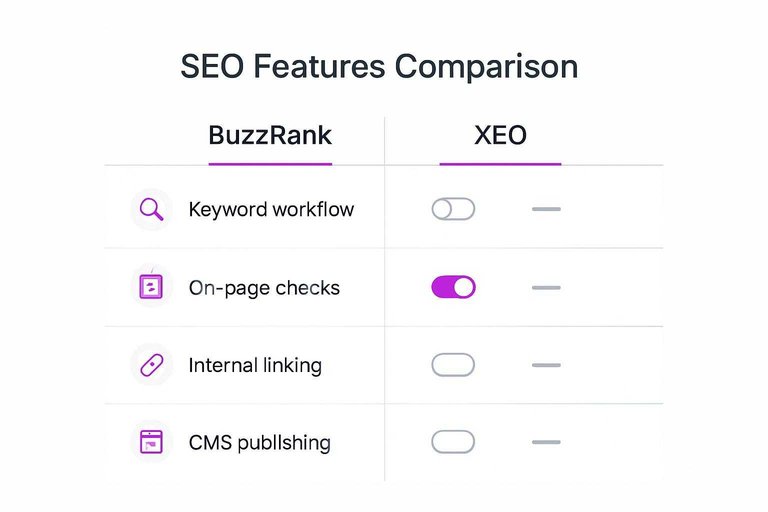
Autopilot SEO only works when the tool covers the boring, repeatable details. Compare what BuzzRank and XEO actually automate, not what they promise.
| Capability that affects autopilot | BuzzRank | XEO | Notes for real outcomes |
|---|---|---|---|
| Keyword workflow | Varies by plan | Varies by plan | Look for clustering, intent. |
| On-page checks | Basic to advanced | Basic to advanced | Prefer actionable fixes. |
| Internal linking | Limited to robust | Limited to robust | Automation prevents orphan pages. |
| Structured metadata | Partial support | Partial support | Titles, metas, schema. |
| CMS publishing | Depends on integration | Depends on integration | Direct publish saves handoffs. |
If either tool leaves publishing or linking manual, your “autopilot” becomes a weekly chore.
When you notice gaps in both—like hands-off WordPress publishing plus built-in distribution help—Skribra can be a credible third option, since it pairs daily SEO-formatted generation with WordPress integration and a backlink exchange network. If you want a practical framework for what to automate end-to-end, use this checklist for streamlining SEO content.
Integrations and Publishing
Getting content from draft to live is where “autopilot” either feels safe or reckless. You’re evaluating two things at once: CMS fit and guardrails. The best setup publishes fast, but never blindly — and that’s where platforms that combine native CMS integrations with explicit workflow controls tend to feel more dependable in day-to-day use.
CMS compatibility
Most teams want WordPress publishing, plus a fallback when the integration breaks. Headless CMS support matters if your site is more app than blog.
Look for:
- Native WordPress connection vs API-only publishing
- Support for headless CMS via REST, GraphQL, or webhooks
- Draft exports like HTML, Markdown, and DOCX
- Asset packaging for images, captions, and metadata
If BuzzRank or XEO locks you into one path, you’ll feel it at scale — especially if you’re trying to keep publishing consistent without rebuilding your pipeline. Tools like Skribra can be worth weighing here when WordPress is the center of gravity, since native publishing plus flexible integration options (like webhooks) gives you a cleaner fallback strategy.
Automation triggers
Triggers decide whether your system runs itself or waits on you. Evaluate what you can kick off without opening the tool.
- Schedule posts by cadence
- Fire webhooks from events
- Ingest topics from RSS
- Alert on keyword movement
- Refresh content by rules
If you can’t trigger reliably, “autopilot” becomes reminders and tabs. A practical tell is whether the platform supports the kinds of triggers your team already uses (scheduling plus webhooks is often the baseline), since that’s what keeps content ops from bottlenecking when volume grows.
Internal linking setup
Internal linking is where many AI workflows quietly fail. They publish pages, but they don’t build a structure.
Compare how BuzzRank vs XEO handle:
- Link suggestions based on existing URLs and anchors
- Hub-and-spoke planning across a topic cluster
- Cannibalization checks for overlapping intent
If neither tool gives you confident link governance, Skribra is a credible third option to consider because it pairs WordPress publishing with workflow-friendly automation hooks, which helps enforce structure without manual copy-pasting — especially when you’re standardizing metadata and formatting alongside the link plan.
Asset handling
Publishing breaks when assets are inconsistent. You want images and formatting to land correctly every time.
- Generate images with prompts
- Set featured image reliably
- Produce alt text consistently
- Apply template formatting rules
- Preserve captions and credits
If assets don’t travel cleanly, your “published” pages still need hand-fixes. In practice, it helps when your content system treats images and metadata as first-class parts of the publishing workflow (for example, generating images and carrying alt text through to WordPress), so “done” actually means publish-ready.
Pricing and Predictability
Pricing is where “autopilot” either stays boring or becomes a weekly surprise. You’re not just buying words. You’re buying operational certainty.
Costs usually scale in four places: content volume, seats, sites, and add-ons. The gotcha is the fifth place. Human time.
| Cost driver | BuzzRank: what tends to happen | XEO: what tends to happen | Hidden operational cost |
|---|---|---|---|
| Content volume | Tiered usage limits | Tiered usage limits | Overages and throttling |
| Users and seats | Per-seat or role limits | Per-seat or role limits | Approval bottlenecks |
| Sites and brands | Per-site pricing | Per-site pricing | Template drift |
| Add-ons and integrations | Paid connectors or upgrades | Paid connectors or upgrades | Zapier and monitoring |
| Output quality control | QA features vary | QA features vary | Editing and rewrites |
If your plan looks cheap, price in the labor you’ll spend keeping it “cheap.”
If you want fewer moving parts, Skribra is a credible third option to compare here. It pairs daily SEO articles with WordPress publishing, images, and a backlink exchange network. That can reduce add-on sprawl, but you still need to validate fit for your workflow.
Predictable spend comes from predictable operations. Pick the tool that matches how your team actually ships content.
Low-Risk Pilot Plan and Evaluation Checklist
If you’re already down to BuzzRank vs XEO, the fastest way to make a confident choice is a time-boxed pilot with clear pass/fail criteria. The goal isn’t to “see if AI works” in general—it’s to verify whether this workflow can reliably produce publishable pages in your niche without creating cleanup work, brand risk, or reporting ambiguity.
Below is a practical pilot you can run with either tool (or both in parallel) using the same inputs, the same rules, and the same scoring. Keep the scope small, buyer-intent heavy, and measurable.
Set the pilot guardrails (what you will and won’t test)
Use a 2–3 week window or a fixed article count (whichever comes first). Make the rules explicit before you generate anything:
- Pick one site + one niche: Avoid cross-site comparisons where domain strength or existing topical authority skews results.
- Choose 6–10 keywords with mixed difficulty:
- 2–3 bottom-of-funnel (“pricing”, “alternatives”, “vs”, “reviews”)
- 2–3 mid-funnel (“best X for Y”, “X software for Y”)
- 2–4 informational cluster posts that support the commercial pages
- Define what “publishable” means: e.g., meets brand voice, includes required sections, uses sources/citations where you require them, and passes your compliance rules.
- Lock the same inputs across tools: brand brief, target audience, offers, CTA rules, internal linking rules, and any banned claims/words.
- Limit human editing time: Set a cap (example: 20–30 minutes per article). If it routinely exceeds the cap, that’s a signal—not a one-off.
Run either A/B or sequential—here’s the cleanest comparison
To reduce variables, pick one of these methods:
- Parallel A/B (best for teams): Each platform produces the same 6–10 pages from the same brief. You publish only the “winning” versions, but you score both.
- Sequential (best for solo operators): Run Platform A for half the set, Platform B for the other half—but keep keyword difficulty balanced across both halves.
Whichever you choose, keep the evaluation focused on what matters operationally: how much supervision is needed, how predictable publishing is, and whether the system helps you maintain rankings after launch.
Buyer-intent evaluation checklist (score it like a vendor selection)
Use a simple 0–2 scoring (0 = missing/failed, 1 = partial, 2 = consistent). Total score isn’t everything, but it prevents “vibes-based” decisions.
1) Workflow fit and throughput
- Can you go from keyword → outline → draft → publish without manual glue work?
- How many handoffs are required (SEO → writer → editor → CMS)?
- Can it operate as an autopilot without constant prompt babysitting?
2) Control and risk management
- Can you enforce a brand brief and required structure consistently?
- Can you prevent unsupported claims (and does it flag them for review)?
- Can you set guardrails for YMYL/compliance-sensitive content (medical, finance, legal)?
3) On-page SEO hygiene
- Does it produce clean titles, headings, and internal link suggestions that match your site architecture?
- Does it avoid cannibalization (duplicate titles, overlapping intent) across the pilot set?
- Does it create content that matches search intent without padding?
4) Editing burden
- Average time to bring a draft to publishable quality.
- Most common fixes required (facts, tone, structure, missing sections, weak CTA).
- Whether fixes are “one-time settings” or per-article firefighting.
5) Publishing and operational reliability
- Does it publish where you need it to, with correct formatting (tables, images, FAQs, schema if applicable)?
- Can you control scheduling, categories/tags, and authoring rules?
- Are there failure points you’d need to monitor daily?
6) Measurement and post-publish iteration
- Can you tie outputs to outcomes you care about (rankings, impressions, clicks, leads) without heavy manual reporting?
- Does it support updating/refreshing content based on performance signals?
- Can you capture “what changed” so your team can learn and standardize?
7) Cost predictability
- Is pricing aligned with how you actually work (volume spikes, client sites, revisions, team seats)?
- Are there hidden constraints (limits on keywords, refreshes, publishing destinations, or integrations) that change your effective cost?
At the end of the pilot, you should have: (1) a publishable content batch, (2) an average editing time per piece, (3) a clear list of recurring issues, and (4) an answer to a single question: Which tool produces acceptable pages with the least supervision and the fewest surprises?
Pilot success criteria (decide before you start)
Choose 3–5 hard criteria so the pilot ends with a decision.
Common pass/fail criteria:
- Quality: X out of Y articles published with edits under your time cap.
- Consistency: The tool follows your structure/voice without per-article re-instruction.
- Risk: No repeated unsupported claims or compliance red flags.
- Ops: Publishing workflow works end-to-end (including formatting and scheduling) with no recurring breakpoints.
- Maintainability: You can update content later without rewriting everything from scratch.
If both pass, pick the one that is easier to standardize across clients and team members—because that’s what compounds over time.
Pick Your Autopilot, Then Prove It in a 2-Week Trial
- Choose your starting bias: pick BuzzRank if you want a more guided, structured workflow; pick XEO if you value flexibility and tinkering with automation logic.
- Run the same pilot on both: publish a small batch (e.g., 10–20 pieces) with identical briefs, templates, and internal-link rules, and track edits required for voice, accuracy, and on-page SEO.
- Stress-test the failure modes: intentionally vary topic difficulty, add sources/claims, and push through your real CMS + image process to see where approvals, formatting, or linking breaks.
- If neither fits cleanly, evaluate a third option: Skribra can be worth considering when you need WordPress-first publishing, webhook-based automation, and built-in image generation—plus a backlink exchange network—especially if you find gaps in either tool’s publishing flow or off-page support.
Frequently Asked Questions
- Is BuzzRank or XEO safer for “hands-off” AI SEO content autopilot without risking spam or factual errors?
- Neither is truly hands-off by default—set mandatory human review for sensitive topics, enforce source/citation rules, and require pre-publish QA checks (links, claims, schema, and internal linking) to reduce risk regardless of tool.
- Can BuzzRank or XEO publish at scale without causing keyword cannibalization across similar AI-generated pages?
- Yes, but only if you control topic clustering and URL mapping: maintain a keyword-to-page map, use one primary intent per page, and add a cannibalization check in Google Search Console and your rank tracker before pushing more pages live.
- How do I evaluate BuzzRank vs XEO in a pilot test without waiting months for SEO results?
- Run a limited batch on a single site section and compare leading indicators like indexation coverage, impression growth in Google Search Console, crawlability, and content QA pass rate before scaling volume.
- Do BuzzRank or XEO work well for programmatic SEO pages and templates, or are they better for editorial blog posts?
- They can support both, but programmatic SEO usually needs stricter templates (fields, constraints, and validation) and automated duplication checks, while editorial posts need stronger briefing, entity coverage, and editorial style controls.
- What’s the best alternative if I want AI SEO content autopilot with WordPress publishing and a built-in backlink option?
- If those are must-haves, Skribra is worth considering because it supports WordPress publishing and includes a backlink exchange network, which can simplify distribution and authority-building alongside ongoing content output.
Automate Your AI SEO Pipeline
Comparing BuzzRank vs XEO clarifies the tradeoffs, but the real win is a workflow that publishes consistently with predictable quality and cost.
Skribra delivers daily SEO-optimized articles with WordPress publishing, images, and quality controls built in—start with the 3-Day Free Trial to see it run hands-free.
Written by
Skribra
This article was crafted with AI-powered content generation. Skribra creates SEO-optimized articles that rank.
Share: