October 5, 2026
·
13 min read
Buzzword Alternatives for Programmatic SEO and Bulk Content
Client-ready phrasebook for programmatic SEO/bulk content: choose template+data pages, ContentOps, or faceted crawl control—and the safeguards to cite.

You’re trying to pitch a scale-content initiative without sounding like you’re asking permission to publish junk. The wrong label can derail approval, invite the wrong compliance questions, or lock your team into expectations you can’t (or shouldn’t) meet.
This collection helps you choose precise, client-friendly language by separating three commonly mixed-up projects—template-driven landing pages from a dataset, high-velocity editorial ContentOps, and managing faceted URL sprawl—and pairing each with proposal-ready safeguards (what gets indexed, what gets blocked, and how you prevent doorway-like duplication).
Why Buzzwords Backfire
“Programmatic SEO” and “bulk content” sound like a promise of volume first and value later. In client conversations, compliance reviews, and internal approvals, that phrasing often triggers the same question: “Are we paying to manufacture pages?” The problem isn’t that scaling is forbidden—it’s that these buzzwords are strongly associated with scaled, low-value patterns.
What Google Flags
Google’s spam policy language is blunt about what crosses the line. Scaled content abuse—Google’s term for producing many pages mainly to manipulate rankings, instead of helping users—applies whether those pages are made by automation, humans, or a mix of both.
A second label matters just as much in proposals: doorway abuse, meaning pages created to rank for lots of similar queries that funnel users into a less-useful intermediate step instead of satisfying the intent on the page itself. Google’s examples include many city/region pages that all push people to one destination page, or “substantially similar” pages that sit between the search results and a real browseable site structure.
When you pitch “bulk” or “programmatic,” stakeholders tend to map that language to these two categories—because they’ve seen them used together.
Tools Aren’t The Issue
Google doesn’t frame the risk around your tooling. It frames it around outcomes: are you scaling pages that add user value, or scaling pages that exist to rank.
That’s why Google’s generative AI guidance focuses less on “AI vs. not-AI” and more on “value vs. no value,” explicitly warning that generating many pages without adding value can violate the scaled content abuse policy. It also calls out a practical requirement teams gloss over: AI outputs can be inaccurate and should be manually reviewed and fact-checked before publishing.
This is where AI-assisted drafting—using generative AI for research, structure, or first drafts with human review and fact-checking—reads as a quality system, not a volume tactic.
Pick Your Work Type
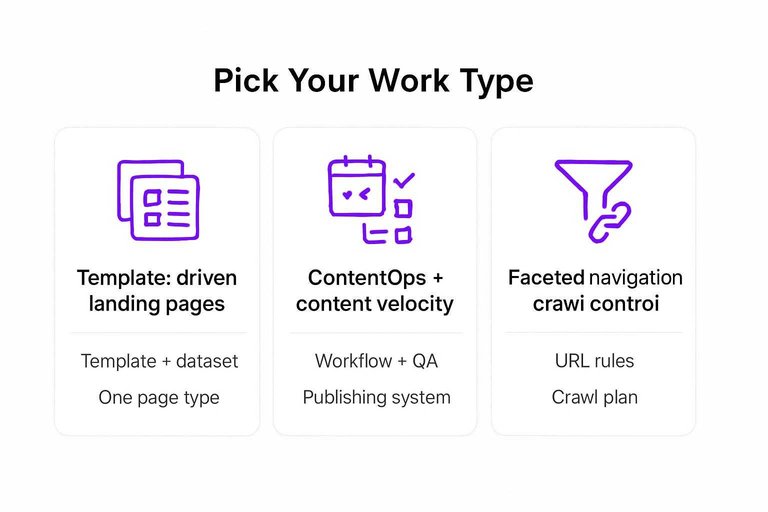
Most “programmatic SEO” conversations are really about one of three deliverables. If you pick the wrong label, you’ll scope the wrong work.
Programmatic SEO (pSEO)—generating many search-targeted pages from a shared template populated by a structured dataset (one URL per row/combination)—isn’t the same thing as automating SEO work in general (audits, outreach, analytics), even though some people use the term that way. Backlinko’s definition is explicitly the template+data approach: systematic creation of content at scale using templates and data to create “landing pages at scale,” often targeting thousands (sometimes millions) of related queries. When your deliverable is the repeatable page shape itself, “template-driven landing pages” is the plain-English name that doesn’t imply “SEO automation.”
Bulk content generation—producing many content assets in one batch (articles, product copy, landing pages, ads, social), typically tool-led and output-focused—also isn’t the same as content operations (ContentOps), meaning the people/process/technology system that plans, produces, governs, publishes, measures, and maintains content at scale. Content velocity is the throughput metric here: the rate your team ships new or updated content over time. This is also where platforms built specifically for consistent SEO publishing (e.g., Skribra, with keyword-aware formatting, meta descriptions, and direct WordPress publishing) tend to fit more naturally than in “template + dataset” pSEO—because the deliverable is ongoing editorial throughput, not a single template producing thousands of URLs, and the real constraint is often fixing content bottlenecks with smart AI rather than creating more templates.
Finally, some “we need pages at scale” problems are really faceted navigation URLs—filter/sort/pagination combinations that generate large numbers of parameter/path URLs. That’s not “more pages to write”; it’s URL multiplication that can create a virtually infinite URL space and soak up crawl attention.
| Work type (the bucket) | What you’re building | Core deliverables | What to call it in a brief | Commonly mislabeled as |
|---|---|---|---|---|
| Template + dataset landing pages | One page type, many URLs | Template, dataset, rules | Template-driven landing pages | “SEO automation” / “bulk content” |
| Editorial scaling / ContentOps | A maintained publishing system | Workflow, QA, calendar (often supported by publishing automation) | ContentOps + content velocity | “Programmatic SEO” |
| Crawlable URL multiplication | A crawl/indexing problem | URL rules, crawl plan | Faceted navigation crawl control | “Programmatic pages” |
If you can’t point to “the template + the dataset” (row 1) or “the ops system” (row 2), you’re usually in row 3—and the fix is URL governance, not more content.
Most “programmatic SEO” conversations are really about one of three deliverables. If you pick the wrong label, you’ll scope the wrong work.
Programmatic SEO (pSEO)—generating many search-targeted pages from a shared template populated by a structured dataset (one URL per row/combination)—isn’t the same thing as automating SEO work in general (audits, outreach, analytics), even though some people use the term that way. Backlinko’s definition is explicitly the template+data approach: systematic creation of content at scale using templates and data to create “landing pages at scale,” often targeting thousands (sometimes millions) of related queries. When your deliverable is the repeatable page shape itself, “template-driven landing pages” is the plain-English name that doesn’t imply “SEO automation.”
Bulk content generation—producing many content assets in one batch (articles, product copy, landing pages, ads, social), typically tool-led and output-focused—also isn’t the same as content operations (ContentOps), meaning the people/process/technology system that plans, produces, governs, publishes, measures, and maintains content at scale. Content velocity is the throughput metric here: the rate your team ships new or updated content over time. This is also where platforms built specifically for consistent SEO publishing (e.g., Skribra, with keyword-aware formatting, meta descriptions, and direct WordPress publishing) tend to fit more naturally than in “template + dataset” pSEO—because the deliverable is ongoing editorial throughput, not a single template producing thousands of URLs, and the real constraint is often fixing content bottlenecks with smart AI rather than creating more templates.
Finally, some “we need pages at scale” problems are really faceted navigation URLs—filter/sort/pagination combinations that generate large numbers of parameter/path URLs. That’s not “more pages to write”; it’s URL multiplication that can create a virtually infinite URL space and soak up crawl attention.
| Work type (the bucket) | What you’re building | Core deliverables | What to call it in a brief | Commonly mislabeled as |
|---|---|---|---|---|
| Template + dataset landing pages | One page type, many URLs | Template, dataset, rules | Template-driven landing pages | “SEO automation” / “bulk content” |
| Editorial scaling / ContentOps | A maintained publishing system | Workflow, QA, calendar (often supported by publishing automation) | ContentOps + content velocity | “Programmatic SEO” |
| Crawlable URL multiplication | A crawl/indexing problem | URL rules, crawl plan | Faceted navigation crawl control | “Programmatic pages” |
If you can’t point to “the template + the dataset” (row 1) or “the ops system” (row 2), you’re usually in row 3—and the fix is URL governance, not more content.
Phrasebook Alternatives
These labels are designed to describe the deliverable—not the hype. Each one is written as a “use X when…” line you can drop into a brief, SOW, or procurement questionnaire without implying “spam at scale.”
Template System Labels
Use these when you’re shipping a repeatable page template populated by a structured dataset (a shared skeleton with variable fields).
-
“Template-driven landing pages (dataset-backed)” — Use when you’re generating many URLs from one page type and a table/feed.
-
Examples: location pages, comparison pages, category hubs.
-
Specify: dataset source + the exact fields that render on-page (for example: name, address, service area, price points, feature flags).
-
“Data-driven location pages” — Use when each page is anchored to a real-world entity record.
-
Examples: store finder pages, service areas, practitioner locations.
-
Specify: the entity dataset and required fields (NAP, hours, coordinates, coverage rules) and who owns freshness.
-
“Comparison matrix pages (structured attributes)” — Use when the page is a template plus a set of comparable attributes.
-
Examples: “X vs Y” pages, alternatives pages, plan/pricing comparisons.
-
Specify: the comparison schema (attributes/definitions), allowed sources for each attribute, and update cadence.
-
“Category hub + index pages (feed-rendered)” — Use when you’re building browseable hubs where the primary content is a filtered/sorted list.
-
Examples: product category hubs, directory-style indexes.
-
Specify: listing fields (title, price, availability, ratings), sort/filter rules, and what qualifies an item to appear.
-
“Template + data-layer content generation (fields first)” — Use when you want to be explicit that the work is “syntax-based”: pages are rendered from variables, and any generative copy is just one way to fill specific fields.
-
Specify: which fields are deterministic (pulled from the data layer/database/spreadsheet/CMS/API) vs. which fields are drafted text.
ContentOps Scale Labels
Use these when the deliverable is an operating system for content, not a batch of pages. Keep “velocity” as a throughput metric, not a quality promise.
-
“Content operations (planning → review → publishing → maintenance)” — Use when your scope includes workflow and governance across the full lifecycle.
-
Specify: owners for each stage, review gates, and the maintenance trigger (time-based, performance-based, or both).
-
“Editorial production pipeline” — Use when you need ops-first language that reads like process engineering.
-
Specify: intake (briefs), QA requirements (source checks), approvals, and publishing controls.
-
“AI-assisted drafting with human review and source checks” — Use when AI is part of the workflow but the acceptance criteria are human-owned.
-
Specify: what must be reviewed (facts, claims, citations, internal links) before publishing.
-
“Search Console–driven refresh workflow” — Use when the maintenance plan explicitly uses Google Search Console performance data to prioritize updates.
-
If you use a platform like Skribra for this, keep the label about the workflow, not the tool.
-
“Merchant Center–compliant AI asset labeling” — Use when ecommerce content includes AI-generated product imagery or AI-generated product data.
-
Specify: AI-generated images must include IPTC metadata (a standard for embedded image metadata) with
DigitalSourceTypeset toTrainedAlgorithmicMedia, and AI-generated product titles/descriptions must be separated and labeled as AI-generated.
Crawl Control Labels
Use these when the problem is facet/parameter URL multiplication. Your label should make it obvious whether facets are blocked or intentionally indexable.
-
“Faceted navigation crawl control (blocked facets)” — Use when you do not need filtered combinations crawled.
-
Specify: the URL patterns to block via
robots.txt, or implement filters as URL fragments (#) so they don’t create crawlable URLs. -
“Indexable facet strategy (optimized facets)” — Use when specific filters must be crawlable/indexable (for example, a small set of high-intent filters).
-
Specify: standard
&separators, consistent filter ordering, 404 for empty combinations, and avoid redirecting empty results. -
“Parameter URL governance” — Use when you’re defining rules across query parameters, pagination, and sorting.
-
Specify: which parameters are allowed to produce indexable URLs vs. which are controlled to prevent a virtually infinite URL space.
Proposal Safeguards
-
Define what can be indexed (and what must never be).
Write the proposal as an allowlist: which URL patterns are “indexable pages” vs “non-indexable states.” Use robots.txt disallow (a crawl control that can prevent Googlebot from fetching certain URL patterns, commonly used to block low-value facets/parameters) for whole classes of URLs you don’t want fetched at all, and use URL fragments (#) for filters (a filter-state approach Google notes because Google Search generally doesn’t support fragments for crawling/indexing) to avoid creating crawlable URLs in the first place. -
Consolidate unavoidable URL variants instead of letting them compete.
Where multiple URLs represent the same or near-same page, commit to rel=“canonical” (a hint pointing Google to the preferred URL when multiple URLs represent similar content, often used to consolidate signals across variants) and specify which variant is canonical by rule (ordering, parameter rules, trailing slashes, etc.). -
Put “doorway” boundaries in plain acceptance criteria.
Define a doorway-like pattern as: “many near-identical pages whose main job is to rank for slightly different queries and push the user to a different destination.” Then add proposal controls:
- Each indexable page must satisfy the primary intent on the page itself.
- If multiple pages funnel to the same end page, they’re out-of-scope for indexing.
- Pages that are “substantially similar” by template + data are blocked or canonicalized, not multiplied.
-
Prove uniqueness/value before you scale.
Add a pre-scale gate: ship a small, representative set and review it for duplicated intent, thin data records, and template fields that produce near-identical output; only then approve expanding the dataset or combinations—using an SEO content streamlining checklist to keep the review consistent. -
Choose a faceted-navigation policy: block or optimize—don’t do neither.
Google Search Central frames two legitimate paths for faceted URLs: block them when you don’t need them indexed (robots.txt disallow or fragments), or deliberately optimize a limited set you truly want crawled/indexed—because crawling large facet spaces is a real resource cost.
If your safeguards read like controls (allowlists, patterns, gates), your plan stops sounding like “volume” and starts sounding like governance.

When To Avoid The Buzzwords
If the label creates more risk than clarity, drop it. Your brief should describe the deliverable and the controls, not the hype term.
-
When the room already associates “pSEO” with spam. Ahrefs quotes Google’s John Mueller calling “Programmatic SEO” “often a fancy banner for spam.” In that situation, say: “template-driven landing pages with an indexability allowlist and a pre-scale review gate.”
-
When “programmatic SEO” is being used in two different ways. Some teams mean “templated pages from a dataset,” others mean “automating SEO work” (audits, outreach, analysis). If you’re not 100% sure everyone means the same thing, write: “SEO workflow automation” or “template + dataset page system”—whichever you’re actually building.
-
When the plan is a one-time batch, not a maintained system. Don’t promise “ContentOps” or a “content engine” if you’re doing a single push. Say: “one-time content batch with manual review and fact-checking before publish; no maintenance included.”
-
When you can’t name who owns freshness. If nobody is accountable for dataset updates, approvals, and removals, don’t pitch scale. Scope it as: “pilot set of X pages + governance rules (what gets indexed, blocked, or canonicalized).”
-
Tool-fit reality check: Byword vs. a maintained system. Pick Byword (https://byword.ai/ rel=“nofollow”) when you want a predictable monthly article output with bulk generation (Campaigns), templates/datasets, and direct CMS publishing via integrations or API/webhooks. Prefer a maintained system like Skribra when the scope includes planning, publishing, and post-publish refresh using Search Console signals—not just generation. Note the catch: Byword’s integrations are paid-plan only, and its pricing page doesn’t publish annual pricing.
Pitch the deliverable, not volume
If you want approval for “scale,” stop selling a buzzword and start naming the exact deliverable—template-driven landing pages, ContentOps/content velocity, or faceted navigation crawl control—plus the controls that keep you out of scaled-content and doorway territory (an indexability allowlist, canonical rules, and a pre-scale review gate with human fact-checking). When the scope is a maintained publishing system with ongoing refresh work, Skribra is the cleanest fit because it’s built around planning → publishing → Search Console–driven maintenance, not just generation. If what you actually need is a predictable monthly batch of SEO articles or template+dataset generation with automation hooks and direct CMS publishing, choose Byword (https://byword.ai/ rel=“nofollow”)—and be explicit in the brief that it’s a one-time batch with review, not an “engine.” And if the “pages at scale” pain is really parameter/facet URL multiplication, don’t label it content at all: sell URL governance (block or optimize) so crawl and indexation stay intentional.
Frequently Asked Questions
- Is “programmatic SEO” the same thing as SEO automation?
- Not the same thing: many teams use “programmatic SEO” to mean template + dataset landing pages, while others use it to mean automating SEO work like audits, content creation, outreach, and analytics. In a brief, name the deliverable explicitly (e.g., “template-driven landing pages” or “SEO workflow automation”) so stakeholders don’t scope the wrong work.
- Why does “programmatic SEO” sound spammy to clients and compliance teams?
- Because the term is widely associated with low-value scaled page patterns—John Mueller has called programmatic SEO “often a fancy banner for spam.” Use deliverable-first language (“dataset-backed landing pages with indexability rules and review gates”) to reduce that immediate risk signal.
- Does Google treat AI-generated content as spam in 2026?
- Google’s guidance on using generative AI content was last updated on October 1, 2026, and it focuses on whether the page is helpful—not whether AI was used. If you use AI, bake in human review and fact-checking as a publish gate rather than pitching “AI at scale” as the deliverable.
- What should I put in an SOW instead of “bulk content” to make the scope defensible?
- Write the scope as a deliverable plus controls: “editorial production pipeline” or “content operations (planning → review → publishing → maintenance)” with named QA gates, indexability rules by URL pattern, and a pre-scale pilot requirement. This keeps the conversation on governance and acceptance criteria instead of volume.
- What’s the simplest way to avoid “doorway page” accusations when scaling location or comparison pages?
- Make each indexable page satisfy the primary intent on-page, and block or canonicalize near-duplicates that exist mainly to rank for slight query variants and funnel users elsewhere. Put that rule in acceptance criteria (“if multiple pages funnel to the same destination, they are not indexable”) so it’s enforceable.
Turn briefs into maintained rankings
Once you’ve swapped hype labels for clear deliverables and safeguards, the next bottleneck is executing consistently—planning, publishing, and refreshing pages before performance drifts.
Skribra is an AI-driven SEO content system that pulls keywords, builds a rolling 30-day content calendar, publishes to your CMS, and uses Search Console data to maintain existing posts; start with the 3-Day Free Trial.
Written by
Skribra
This article was crafted with AI-powered content generation. Skribra creates SEO-optimized articles that rank.
Share: