September 8, 2026
·
12 min read
9 Autoblogging Mistakes That Trigger Thin-Content Issues
A diagnosis-first troubleshooter that pinpoints which autoblogging pattern is behind thin-content issues — Wrong Console Signal checks, Volume-First Autoblogging, Scraped Source Mashups, Doorway Page Factories, Thin Affiliate Templates, Expired Domain Shortcuts, Duplicate URL Inventory steps, and a Fix Order Decision Tree with Skribra safeguards — so the right remediation comes first.

You turned on automation to publish faster, and now your pages aren’t getting indexed, rankings are sliding, or you’ve been flagged for low-value content. The hard part isn’t “fixing SEO” — it’s figuring out which specific workflow created the pattern search engines reject.
If you chase the wrong signal, you can waste weeks rewriting posts that should be consolidated, blocked, or removed, while the real problem keeps spreading across your URL set. This troubleshooter walks you through nine common autoblogging mistakes, what they look like in practice, and how to choose the first fix that actually matches the issue.
Wrong Console Signal
Diagnose thin-content fallout by starting with the report that can prove the failure mode.
-
Open Search Console → Manual actions report first
If you see “Thin content with little or no added value” (a manual action label for shallow/low-value pages), you’re not dealing with “indexing weirdness.” Google explicitly ties this to examples like thin affiliate pages, content from other sources (including scraped content or low‑quality guest posts), and doorways—all treated as spam-policy violations (see the Manual actions report). -
If Manual actions is clean, move to the Page indexing report
You’re now diagnosing selective indexing/exclusion. Look for Soft 404 (a page that returns HTTP 200 but effectively behaves like “not found/empty,” so Google may classify it as an indexing issue) and other exclusion statuses. -
Use the URL Inspection tool on a handful of autoblogged URLs
Pick: (a) a page you expected to rank, (b) a page from a new batch, and © a template-heavy page. Check whether each is Indexed or showing an exclusion like soft 404. -
Only after indexing checks, think “ranking suppression”
If URL Inspection says a page is indexed, but it still doesn’t surface for its target query set, you’re in ranking territory—an algorithmic quality/value problem, not an indexing problem. -
Apply the fix that matches the label
Manual action → policy cleanup + reconsideration path. Exclusion → fix empty/placeholder/autogenerated endpoints. Indexed-but-invisible → improve added value, not submission mechanics.
Getting this label wrong is how teams waste weeks “fixing SEO” on a problem that was actually enforcement—or the reverse.
Volume-First Autoblogging
Autoblogging is any workflow where software publishes posts to your site automatically (from feeds, templates, or AI) with little human editing. The “best free autoblogging plugin” for WordPress is whichever one gives you a kill switch—publish to draft instead of public, pause ingestion, and force review—because thin-content blowups usually come from an unattended batch, not the plugin brand.
-
Map your pipeline, not your prompts
Write the exact path: source → transformation → template → publish → interlink. Your risk lives in what stays the same across hundreds of URLs. -
Flag scaled content abuse early
Scaled content abuse means generating many pages mainly to manipulate rankings (often unoriginal and low value), regardless of whether humans, AI, or both produced them. If you’re shipping large batches where the main “innovation” is new keywords and new URLs, treat it as a scaled-content-abuse risk first (per Google’s Spam Policies for Google Web Search). -
If the input is other sites, test for scraping behavior
If you republish content from other sites (including feeds or search-result pulls), even with synonym swaps, translations, or light rewrites, without a unique benefit, you’re matching Google’s scraping examples. -
If the output is many near-copies, test for doorway + thin affiliate patterns
If you mass-create similar pages targeting similar queries that funnel users deeper, you’re in doorway-abuse territory. If your affiliate pages reuse merchant descriptions/reviews without original testing, ratings, or comparisons, that’s thin affiliation. -
Check the “why this site?” shortcuts
Buying an expired domain mainly to ride its past signals, then filling it with low-value content, fits expired domain abuse. Hosting third-party content mainly because your site’s reputation helps it rank fits the site reputation policy.
Is blogging still worth it in 2026? Yes—but only if automation is producing pages with real, checkable added value—use an essential AI content checklist to keep quality gates consistent at scale. Google’s spam policies explicitly include using generative AI tools to generate many pages without adding value and scraping feeds/search results to generate many pages as scaled content abuse, even if the text is obfuscated.
Scraped Source Mashups
Scraped source mashups happen when your autoblogging pipeline stitches together other sites’ material. Scraping—copying content from other sites (often automatically) and republishing it to rank, with little or no original value added—has its own bucket in Google’s spam policies.
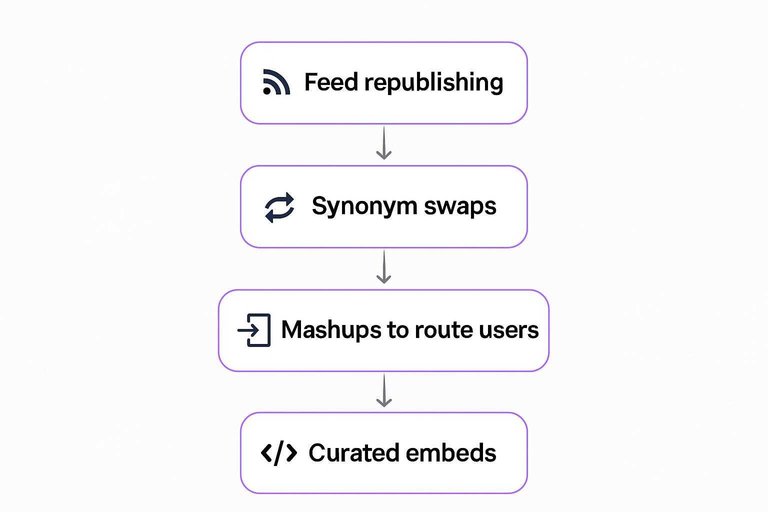
- Feed republishing (RSS/content feeds/search-result pulls) → Scraping / scaled content abuse. Confirm it by spotting posts that read like mirrored feeds with no unique benefit. Fix: stop ingestion, then delete or noindex the batch.
- Synonym swaps / automated paraphrases → Scraping. Confirm it when the page keeps the same structure and facts, just with word substitutions. Fix: remove/noindex near-copies; keep only URLs you can rebuild with new information and original value.
- Mashups that exist to route users to “the real page” → Doorway abuse. Confirm it if you have many substantially similar pages that function as intermediates. Fix: collapse into a clear, browsable hub.
- “Curated” embeds with no work on top → Lowest-quality pattern. Confirm it if almost all main content is copied/paraphrased with little effort or originality. Fix: add original effort before scaling.
Doorway Page Factories
Doorway abuse—creating many similar pages targeting similar queries that funnel users to another destination instead of being useful endpoints—often shows up in autoblogging as “query-page factories.” Google’s spam policies describe it as pages made to rank for specific, similar searches that lead to intermediate pages, including substantially similar pages that sit closer to search results than a clear, browseable hierarchy (see Google’s doorway abuse examples).
- Near-identical query variants: Hundreds of pages where only the keyword changes (city/product/“best” modifiers), but the content and layout stay the same.
- Intermediate-page behavior: The page exists to push the click onward (hard CTAs, “see options,” thin summaries) rather than satisfy the query itself.
- No real hierarchy: Users can’t browse naturally from a hub → category → item; they land on isolated clones instead.
- Scaled output is the giveaway: If automation is producing lots of these primarily to capture rankings, you’re drifting into scaled content abuse territory.
- Fix: Pick the real destination pages, build a browseable hierarchy around them, consolidate query variants into fewer useful endpoints, and delete the leftover doorways.
Thin Affiliate Templates
Affiliate autoblogs make money by sending clicks to a merchant with tracking links; if a purchase happens, you earn a commission. Thin affiliation—affiliate pages that copy merchant descriptions/reviews without original value (no original testing, comparisons, or insights)—is what you get when the template is the content.
| Autoblogging workflow | Closest policy bucket | What Google sees | What “added value” looks like |
|---|---|---|---|
| Paste merchant copy + specs | Thin affiliation | Copied main content | Original testing + ratings |
| Pull reviews via feeds/APIs | Scraping + thin affiliation | Republished reviews | Your verdict, not excerpts |
| Spin 1,000 “best X” lists | Scaled content abuse | Unoriginal at scale | Narrow list you evaluated |
| Location “deals” page clones | Doorway abuse | Intermediary funnels | One browsable hub page |
| Third‑party coupons on strong site | Site reputation abuse | Host signals leased | Real oversight or remove |
Confirm the bucket by spot-checking a few money pages: if the wording/structure matches the merchant or other affiliates, you’re in “copied/paraphrased with little to no added value” territory. Don’t try to outrun it with word count—Google explicitly flags writing to a target length as a bad signal.
Myths That Waste Time
Thin-content fixes stall when teams debate whether it was AI instead of auditing whether the URL set matches Google’s buckets (scaled content abuse, scraping, doorways, thin affiliation).
Myth 1: “AI content is auto-penalized.” Google’s spam policies focus on intent and value, not the mere use of automation. Google’s 182-page Search Quality Evaluator Guidelines don’t treat generative AI use, by itself, as a reason for a Page Quality rating. What earns the “Lowest” rating is content that’s copied/paraphrased/reposted with little to no effort, originality, or added value (see the Search Quality Evaluator Guidelines PDF).
Myth 2: “Thin equals short.” Google’s own helpful-content guidance calls out writing to a target word count because you heard Google prefers one. Length isn’t the standard; effort and added value are.
Myth 3: “Crawled – currently not indexed is technical.” That status doesn’t automatically mean a bug. If the pages were mass-produced mainly to rank and don’t help users, that matches Google’s definition of scaled content abuse—many pages generated primarily to manipulate rankings that provide little to no value.
Here’s what “added value” must look like in an autoblogging template (beyond republishing or paraphrasing):
- Original analysis: your conclusions, not a reworded summary.
- Original testing: your measurements, screenshots, or procedures.
- Real comparisons: your criteria and tradeoffs, consistently applied.
- Unique datasets: your collected numbers, tables, or categorizations.
- Clear oversight: named editor/author review and corrections.
Expired Domain Shortcuts
Expired-domain shortcuts are when your autoblogging relies on a domain’s old links/mentions instead of earning relevance with today’s pages. Site reputation abuse is when you publish third‑party content mainly because your site’s established ranking signals help it rank.
- Spot the tell: a hard topic shift (what the domain used to be about vs. what you’re mass‑publishing now).
- Remove inherited cruft fast: delete (or noindex) whole legacy directories you didn’t rebuild into real destinations.
- Stop “reputation renting”: take down third‑party pages you don’t truly control; Google’s site reputation policy notes that (outside the EEA) violations may trigger a manual action, with notification in Search Console.
- If you keep partner content, own it: real editing, clear accountability, and original work—otherwise don’t host it.
- Pause automation until the site stands on new signals: if rankings collapse without the old domain equity, that’s your bucket.

Duplicate URL Inventory
Autoblogging fails fast when it quietly creates more URLs than content. Audit your inventory the way Google sees it: clusters of duplicates, parameter variants, archives, internal search, and “empty” endpoints.
-
Export every indexable URL, not just your posts
Pull from your XML sitemap(s), CMS URL lists, and Search Console “Pages.” Include tag/category archives, author/date archives, paginated lists, and any on-site search results. -
Cluster URLs by “same page, different address” patterns
Group by:
- Parameters (
?utm=,?sort=,?replytocom=) - Trailing slash / case /
wwwvariants - Paginated archives (
/page/2/) - Printer/AMP-like alternates (if present)
-
Pick the one URL per cluster that should exist
Set a canonical URL (via rel=“canonical”, a signal telling Google which URL is the main version when multiple URLs have duplicate or very similar content) on the duplicates you’re consolidating, and keep the canonical URL consistent across signals. Google Search Central explicitly warns against conflicting canonicalization (for example, one URL in your sitemap but a different canonical via rel=canonical) (see Google’s guidance on consolidating duplicate URLs). -
Decide: canonical vs noindex vs removal (and don’t mix them)
- Canonical: near-duplicate pages you still need reachable.
- Noindex: archives/internal search pages that don’t deserve to land in Google.
- Remove: empty/thin endpoints; Google may flag “page not found” content that still returns HTTP 200 as a soft 404 in Search Console.
- Eliminate crawl traps
If parameters generate infinite combinations, constrain them (site rules, internal linking), and use robots.txt only to stop crawling—never as your primary de-duplication signal.
Fix Order Decision Tree
Fix thin-content fallout in the order Google can re-evaluate it: remove what shouldn’t exist, consolidate what’s duplicated, and only then escalate. If you do it backwards (submitting, requesting reviews, or tweaking prompts first), you keep the low-value URL set in place and the site stays “dirty” from Google’s perspective.
Choose the right fix
-
Prune the unsalvageable first. If a URL is empty, autogenerated filler, or purely there “because the pipeline made it,” remove it and return 410 (Gone) (or a true 404). Also pull it from sitemaps and internal links.
-
If two pages should become one, merge + 301. Combine the best material into a single destination page, then 301 redirect (a permanent redirect) the losers to the winner. Do this when the old URL has any meaningful links or visibility you want to preserve.
-
If duplicates must stay reachable, use rel=canonical. Parameter/sort variants and alternate paths can remain for users, but point them at one primary URL and make every signal agree (canonical tag, internal links, sitemap).
-
If a page is useful for users but not search, noindex it. Add a noindex directive to things like thin archives or internal utilities you don’t want in results.
-
Only if a manual action exists: file a reconsideration request. Use Search Console’s manual-action flow, and describe what you removed, what you consolidated, and what workflow change prevents the same autoblogging batch from returning.
Watch Search Console by sampling with URL Inspection and tracking whether your chosen “winner” URLs stay indexed while the pruned/duplicate set drops out of the Pages report. If you want a process you can run end-to-end, use this checklist for streamlining SEO content to standardize how you prune, merge, and update pages.
Skribra safeguards
- Intent matching: plans content around the search intent so you don’t end up publishing keyword-swap near-identical pages that read like doorway pages.
- Anti-cannibalization controls: filters keywords that would compete with your existing pages, reducing duplicate-at-scale clusters.
- Inline citations: bakes in sourced references so it’s obvious when a draft is just a reworded summary of the same source material.
- Internal links + JSON-LD: ships structured markup and linking so new pages attach to a hub → category → article structure instead of isolated clones.
- IndexNow submission: pushes newly published URLs via IndexNow so discovery isn’t gated by slow crawling.
- Search Console-driven updates: revises live posts based on performance signals instead of only publishing new URLs.
If you need a platform outside WordPress, Shopify, Webflow, Notion, or a webhook, or your content requires hands-on original testing that can’t be templated, a more manual workflow will fit better.
Fix the pipeline, not prompts
Your first job isn’t to “improve SEO”—it’s to name the failure mode: check Manual actions for “Thin content with little or no added value,” then use Page indexing + URL Inspection to separate soft‑404/exclusion issues from indexed-but-invisible quality suppression. Once you know the label, act in the order Google can re-evaluate: pause the unattended batch, prune pages that shouldn’t exist, merge and 301 where two URLs should be one, use rel=canonical for duplicates that must remain reachable, and noindex pages that are useful but don’t belong in search. Only after the low-value URL set is gone does it make sense to escalate (including a reconsideration request when a manual action exists). If you’re going to keep automation, use a workflow with a real kill switch and safeguards like intent matching, anti-cannibalization, citations, and Search Console-driven updates—and if your content requires hands-on original testing or a publishing destination outside the supported integrations, switch to a more manual process instead.
Frequently Asked Questions
- Is autoblogging the same thing as scaled content abuse?
- Not quite. Autoblogging is a publishing workflow, while scaled content abuse is a spam-policy category for generating many pages primarily to manipulate rankings rather than provide original value.
- Why does my autoblogging site show “Soft 404” in Google Search Console when the pages load fine?
- A Soft 404 is when a URL returns HTTP 200 but the page content looks like a “not found” or empty error page to Google’s algorithms, so Search Console flags it in the Page indexing report. Fix it by removing the empty endpoint or serving a real 404/410 for pages that shouldn’t exist.
- Does autoblogging need 1,500+ words to avoid thin content?
- No—Google’s people-first content guidance explicitly calls out writing to a target word count because you heard Google has a preferred length. Build each autoblogged page around unique, checkable added value (original analysis, comparisons, or firsthand input), not a word target.
- Can I run autoblogging safely if I publish everything to draft first?
- Yes—set your autoblogging pipeline to create drafts, then only publish after a human review checks for originality, duplicate URL creation, and whether the page is a useful endpoint (not a doorway). This single gate prevents unattended batches from shipping hundreds of near-copies.
- How do I keep autoblogging from cannibalizing my existing pages with duplicate keywords?
- Use a keyword system that filters out terms likely to overlap your existing URLs, then map one primary intent to one destination page before publishing at scale. Skribra claims it pulls 2,000+ keywords from DataForSEO, which is useful when you need a larger pool to choose from while avoiding obvious topic collisions.
Publish at Scale Without Thin Content
Once you’ve cleaned up the low-value URL set, the next risk is repeating the same failure mode with the next automated batch. You need automation that bakes in intent matching and cannibalization checks from day one.
Skribra runs keyword research, builds a rolling 30-day content calendar, writes long-form posts with citations, publishes to your CMS, and updates articles using Search Console signals—plus a 3-Day Free Trial to validate the workflow.
Written by
Skribra
This article was crafted with AI-powered content generation. Skribra creates SEO-optimized articles that rank.
Share: