September 6, 2026
·
10 min read
11 AI SEO Automation Limitations Worth Knowing in 2026
Learn what hands-off AI SEO automation can’t do in 2026: 12 limits, spam-policy tripwires, Search Console gaps, and required human guardrails.

You want content to ship and refresh itself while you focus on higher-leverage work. But once an automated system is researching keywords, publishing pages, and pushing updates at scale, the failure modes change: it’s easy to cross spam-policy lines, optimize against partial signals, or “fix” pages that were never going to be indexed or shown the way you wrote them.
This case study breaks down what these systems actually automate, then walks through 11 limitations—policy tripwires, telemetry gaps, indexing and presentation you can’t control, and factual/schema risks—ending with a minimum safe autonomy playbook (with a Skribra example) you can apply to any vendor or in-house workflow.
What it automates
AI SEO automation isn’t “using AI to write.” It’s an autonomous loop: software researches keywords and SERPs, drafts a page, publishes it into your CMS, then revisits that live URL to update titles, copy, internal links, and structured data based on performance signals.
Can ChatGPT do SEO? As chat-style assistance, it can help you draft or rewrite, but it doesn’t own the research→publish→update loop: it doesn’t know what actually shipped, what got indexed, or what changed after publish—and it can produce incorrect or misleading output, including fake citations, so the work still needs verification.
In 2026, “ai seo automation” usually refers to these agentic publishing and maintenance systems. That’s also why the real limitations aren’t “writer quality” problems. Google’s March 2024 spam update explicitly targets producing content at scale to boost rankings, whether it’s made by automation, humans, or both, and even the feedback loop is constrained because Search Console data is typically available in 2–3 days rather than in real time.
The 11 limitations
AI SEO automation breaks at the points you can’t “optimize away”: spam-policy enforcement, incomplete Search Console telemetry, and Google-controlled indexing/canonical/title presentation (see this SEO guide for the fundamentals).
| Limitation | Where it shows up | Why it breaks hands-off automation | Required guardrail |
|---|---|---|---|
| Scaled low-value output risk | Programmatic publishing runs | Policy enforcement surface | Value gate + volume caps |
| Doorway-style page patterns | Near-duplicate local/service sets | Looks like a funnel | One intent per URL |
| Reciprocal link-swap footprints | “Link to me” exchanges | Link-spam risk | Hard ban on swaps |
| SERP scraping for rank checks | DIY rank trackers | Machine-generated traffic violation | Use approved sources only |
| Missing queries in reporting | Search Console queries | Long tail invisible | Don’t optimize per-query |
| Truncated performance rows | Search Console exports | Small segments disappear | Store separate analytics logs |
| Bounded history window | Trend-based refresh logic | Baselines fall off | Keep your own archive |
| IndexNow isn’t Google | “Auto-indexing” promises | IndexNow notifies participating engines (not Google), and each engine still decides whether to index | Treat as best-effort only |
| Google-chosen canonical | Similar/duplicated URLs | Your URL won’t be served | Dedupe + canonical hygiene |
| Rewritten title links | SERP presentation | Google may generate the title link from anchors, on-page text, or other sources | Monitor SERP titles too |
| Schema can be suppressed | JSON-LD updates | Rich results can be withheld (or treated as spam) if markup violates quality guidelines or doesn’t represent visible content | Match visible content exactly |
| Wrong facts and citations | Auto-refresh edits | Errors ship faster | Mandatory human verification |
Subsections: []
Spam policy tripwires
With ai seo automation, the fastest way to get burned isn’t “bad writing.” It’s crossing a spam-policy line by shipping patterns that look like manipulation at scale.
Start with scaled content abuse—Google’s spam-policy category for producing lots of content primarily to boost rankings, whether it’s created by humans, automation, or both. Google’s own guidance flags generating many pages with generative AI “without adding value for users” as a violation risk. In an autonomous publish loop, the tripwire is volume-first logic: “cover every keyword variation” becomes the strategy, and usefulness becomes an afterthought.
Next is doorway abuse (doorway pages)—pages created to rank for similar queries that funnel visitors to another destination, rather than serving as distinct, useful endpoints. Google’s spam policies call out examples like generating pages to funnel users into the usable portion of a site and creating substantially similar pages that sit closer to search results than a clear hierarchy. If your automation cranks out near-duplicate local/service pages whose real purpose is “get the click, then route them elsewhere,” you’re in doorway territory.
Then there’s link spam—links created primarily to manipulate search rankings. Google explicitly lists excessive link exchanges (“Link to me and I’ll link to you”) as link spam. Any automation that negotiates reciprocal links, joins “exchange” networks, or templatizes outbound links as a growth lever is not “efficient outreach.” It’s a footprint.
Finally, machine-generated traffic—automated queries to Google (including SERP scraping for rank-checking) that Google treats as a spam-policy violation when done without permission. Google’s spam policies explicitly include scraping results for rank checking and say this kind of automated access violates both spam policies and the Google Terms of Service.
If you want hands-off, treat these four as hard constraints your system must be unable to do by default.

Telemetry isn’t complete
If your ai seo automation loop treats Google Search Console as “the truth,” it will learn the wrong lessons—because it’s not real-time, and it’s not complete.
First, the Performance report is inherently lagged: Search Console says collected data is normally available in 2–3 days. That delay breaks closed-loop behavior like “ship an update, watch the impact, update again,” because you’re reacting to yesterday’s SERP and yesterday’s crawl, not to what your last change actually did.
Second, a chunk of the long tail is invisible by design. Search Console omits anonymized queries—queries removed from reporting to protect user privacy—including queries that only have activity from a few dozen users over a two-to-three month period. If your system optimizes per-query, it over-weights whatever is left.
Third, even what is visible can be skewed. Search Console documents data truncation—it stores and shows only the most important rows—so smaller pages, smaller countries, or niche query variants can disappear from the dataset. That’s a bias problem: your automation “learns” from head terms and big segments, then confidently edits pages as if the tail didn’t exist.
Design your feedback loop to move slower than the telemetry, and optimize at page/intent level rather than chasing individual queries.
Indexing isn’t controllable
URL submission isn’t a switch you flip. Google is explicit that a sitemap can help it discover URLs, but it’s “merely a hint” and doesn’t guarantee Google will even use it for crawling—let alone index the page.
IndexNow—a protocol that notifies participating search engines when URLs are added/updated/deleted, but isn’t an indexing guarantee—has the same limit. Its own participant list includes engines like Bing and Yandex (not Google), and even participants decide independently whether to index what you ping.
That’s why ai seo automation has to verify outcomes, not assume them: check whether the URL is actually indexed, whether Google picked a different canonical (in which case your URL won’t be served in Search), and whether the title link shown in results matches what you published.
Google rewrites outputs
Even if your AI SEO automation system publishes exactly what you approved, Google can present something different.
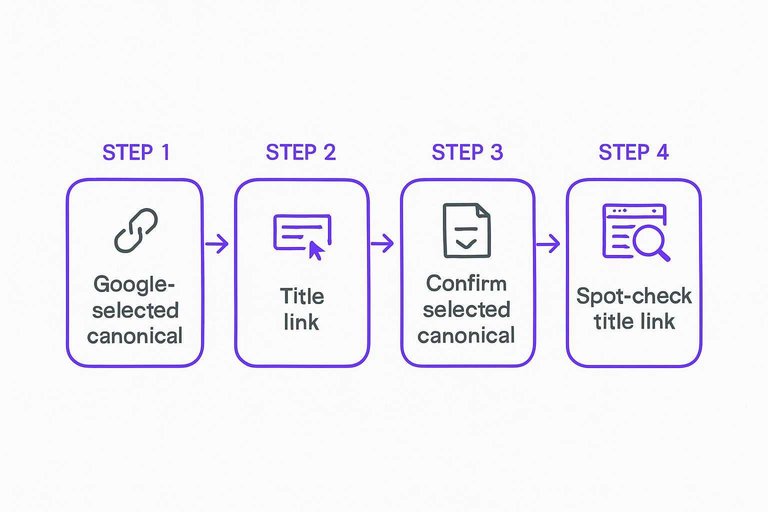
First is Google-selected canonical—the canonical URL Google chooses for a cluster of duplicate/similar URLs, which can differ from the one you declare in rel="canonical" and can prevent your URL from being served in Search. Search Console’s Page indexing report is blunt: when Google has chosen a different canonical, it “will not serve this page in Search.”
Second is the title link—the clickable headline Google shows in results, which can differ from your page’s <title> tag or H1. Google may rewrite it and generate a title link from anchors, on-page text, or other sources.
Operationally, that breaks intent targeting and makes metadata tests noisy. Build verification into the loop: confirm the selected canonical in Search Console, and spot-check the live SERP title link before you trust reporting.
Wrong facts, risky schema
The fastest way for ai seo automation to hurt you is also the most boring: it publishes something confidently wrong, then propagates that wrongness across dozens of pages.
Failure mode one is hallucinated facts and fake citations. OpenAI explicitly warns that ChatGPT can output incorrect or misleading information, including made-up references, and that quotes, data, technical claims, and external-document references must be verified. In an autonomous refresh loop, “verify” can’t mean “looks plausible”—it has to mean “someone (or something) checked the source and the page.”
Failure mode two is structured data that crosses the line into being misleading. JSON-LD— a common format for embedding structured data in a page, often for rich-result eligibility—has to match what users can actually see. Google Search Central warns that violating structured data quality guidelines can keep rich results from showing, and Search Console’s Manual actions report includes structured data actions for markup that’s outside the guidelines, such as marking up invisible, irrelevant, or misleading content.
Acceptance criteria to require from any automation: verify every citation resolves and supports the claim; validate schema output and confirm it matches visible on-page content; and monitor Search Console’s Manual actions report so schema failures don’t sit unnoticed.
Minimum safe autonomy
The best AI SEO automation tool for SEO in 2026 is the one you can constrain: draft-first by default, provable controls against spam-patterns, and rollback when it makes a bad change. If a vendor can’t support that operating model, it’s a no-go—no matter how good the writing looks.
Human control points (minimum safe autonomy)
- Start draft-only. Let the system research and write, but don’t let it publish on day one.
- Approve templates before scale. Lock page types (layout, intent, and “one intent per URL”) before any batch run.
- Set batch limits + an update threshold. Cap how many URLs can ship or be edited per run; require approval for changes that touch titles, canonicals, or schema.
- Run mandatory fact/source checks. No claim ships unless the cited source resolves and supports it.
- Validate structured data. Schema must match visible content or it can be withheld or treated as spam.
- Monitor manual actions. Treat Search Console manual-action checks as a release gate.
- Verify what Google shows. After publish, confirm indexing, the selected canonical, and the title link Google displays.
- Hard-code link rules. Ban reciprocal link swaps and anything that creates link-scheme footprints.
Vendor due diligence (non-negotiables)
- Anti-doorway controls (duplicate/near-duplicate detection and prevention)
- Link-policy enforcement (including a hard ban on exchanges)
- No SERP scraping for rank checks
- Audit logs (who/what changed which URL, and when)
- Throttles + rollbacks (pause and revert batch edits)
- A plan for Search Console limits: lag, truncation, and the 16‑month Performance history window
Skribra example
Skribra is an end-to-end system (keyword → article → publish → refresh), which is exactly where “hands-off” breaks. If it starts from “2,000+ keywords” and turns that into volume-first output, your scaled-output risk becomes a governance problem, not a content problem. Its IndexNow submission can speed discovery for participating engines, but IndexNow doesn’t include Google in the participant list, and even participating engines decide independently whether to index—so your workflow still needs post-publish verification. Finally, if a vendor includes any backlink exchange mechanism, treat it as a bright line: you need an enforceable link policy, plus human gates on facts and JSON-LD changes—use a repeatable review process like this essential AI content checklist.
Constrain automation before you scale
If you want an autonomous research→publish→refresh loop in 2026, treat “hands-off” as the risk—not the goal. Google’s spam-policy tripwires, Search Console’s delayed/partial telemetry, and Google-controlled canonicals/title links mean your system can’t be trusted to optimize safely unless it’s boxed in. The first move is simple: run draft-only until you’ve locked templates, capped batch changes, hard-banned link swaps and SERP scraping, and put mandatory fact + JSON-LD checks plus post-publish verification (indexing, selected canonical, title link) into the release gate. If a tool can’t prove those controls—with audit logs, throttles, and rollbacks—don’t let it publish or update at scale.
Frequently Asked Questions
- What is AI SEO called now—AI SEO, AI SEO automation, or SEO agents?
- “AI SEO automation” and “SEO agents” usually mean an autonomous system that runs the research → draft → publish → update loop on live URLs. “AI for SEO” can also mean chat-based assistance, but that doesn’t control publishing, indexing checks, or ongoing refreshes.
- Can ChatGPT do AI SEO automation end-to-end?
- No—ChatGPT can help draft and rewrite, but it doesn’t own the closed loop of publishing into your CMS, validating what shipped, and updating based on live performance and indexing outcomes. Treat it as a writing/copilot layer, not an automation system.
- Does IndexNow submit my pages to Google, or does it only work on Bing?
- IndexNow notifies participating engines such as Bing and Yandex, but Google is not on IndexNow’s published participant list. Use IndexNow as a discovery ping for those engines and still verify Google indexing separately.
- Why does Google change my page title in the search results even after my AI SEO automation updates it?
- Google can show a different title link than your
tag or H1 and may generate it from anchors, on-page text, or other sources. If you’re testing titles, check the live SERP title link—not just what your CMS published.</dd> <dt>How do I keep AI SEO automation from breaking rich results with bad schema markup?</dt> <dd>Require schema to match the visible on-page content exactly, because structured data that violates quality guidelines can be withheld from rich results or treated as spam. If you want a constrained system to start with, run Skribra in draft-first mode during its 3-day free trial and only approve JSON-LD changes after a visible-content check.</dd> </dl> </section> <section class="cta"> <hr /> <h2>Ship Content Without Blind Spots</h2> <p>Once you’ve defined the guardrails, the hard part is keeping a steady publishing cadence while staying aligned with intent, cannibalization, and what performance data can actually tell you.</p> <p><a href="https://skribra.com/">Skribra</a> turns keywords into a rolling 30-day content calendar, writes long-form articles with citations, and publishes to your site with IndexNow auto-indexing and built-in maintenance agents—backed by a 3-Day Free Trial.</p> </section>
Written by
Skribra
This article was crafted with AI-powered content generation. Skribra creates SEO-optimized articles that rank.
Share: