July 7, 2026
·
Updated July 28, 2026
·
12 min read
Enterprise SEO Agency vs In-House Team: Which Scales Faster?
A clear comparison of enterprise SEO agencies vs in-house teams to determine which scales faster—define “scale,” evaluate operating cadence and momentum, compare capability breadth, and weigh cost, governance, and collaboration tradeoffs.

If “we need to scale SEO” keeps coming up, the real question is what you’re trying to scale: output, impact, coverage, or coordination. That definition changes whether an agency or an in-house team will move faster.
This comparison walks you through the drivers that actually create speed at enterprise—cadence, intake control, tooling and data access, and cross-team influence—then pressure-tests each model on onboarding, capability breadth, cost, risk, and collaboration so you can choose with fewer surprises.
Decision Snapshot
Scaling enterprise SEO is rarely about one clever tactic. It’s about producing more correct work, across more surfaces, with less chaos.
You usually have two paths: hire an enterprise SEO agency, or build an in-house team. The fastest option depends on your constraints, not your ambition.
What “scale” means
Scale in enterprise SEO is about repeatable throughput, not raw output. You’re expanding what you can ship without degrading quality or increasing risk.
Scale shows up in five places: coverage, speed, quality, risk, and sustainability. Coverage means more templates, locales, and content types. Speed means shorter time from insight to release. Quality means fewer regressions and better technical hygiene. Risk means fewer compliance, brand, and legal surprises. Sustainability means the program survives reorgs and staffing churn.
If you can’t explain what you’re scaling, you’ll scale the wrong thing.
Two viable models
Both models can work well. They fail in different ways.
- Agency-led: external specialists run strategy and execution
- In-house-led: internal team owns roadmap and delivery
- Hybrid: in-house leads, agency fills gaps
- Distributed: SEO embedded across product and content
Pick the model that matches your bottleneck, not your org chart.
Who this guide fits
This guide is for organizations where SEO touches many teams. The bigger the surface area, the more coordination becomes the work.
It fits if you’re a fast-growing site adding pages, features, or markets. It fits multi-brand orgs with shared platforms and competing priorities. It fits regulated industries where approvals, claims, and accessibility matter. It fits complex stacks with multiple CMSs, rendering modes, and deployment pipelines.
If you need alignment more than ideas, you’re in the right place.
How to decide
Use a simple lens. Decide based on your limiting factor.
- Set your timeline: when must SEO impact be visible?
- Name your constraints: hiring, approvals, tooling, and engineering capacity.
- Map your complexity: brands, locales, CMSs, and release process.
- Choose accountability: who owns outcomes and tradeoffs?
- Stress-test handoffs: how many teams must cooperate to ship?
The fastest scaler is the one that removes your biggest bottleneck first.
Scaling Drivers
At enterprise, SEO scales when four things line up: people, process, platform, and permission. Agencies often bring extra hands and hardened workflows, but they borrow permission. In-house teams usually own permission, but they fight for bandwidth and shared tooling.
Operating cadence
Cadence decides whether SEO is a system or a series of favors. Agencies tend to impose a repeatable rhythm because they must show progress across accounts.
In-house teams can run a tight loop when they have clear ownership and a standing roadmap review. Otherwise, planning collapses into ad-hoc requests, and prioritization becomes political.
The faster model is the one that turns “SEO work” into a predictable operating meeting, not a monthly panic.
Work intake control
Most enterprise SEO slows down at handoffs, not ideation. These are the usual choke points you need to design around.
- Approval chains for titles, templates, and taxonomy
- Dev queues competing with revenue features
- Content governance across brands and regions
- Legal review for claims, YMYL, and compliance
- Stakeholder alignment on priorities and ownership
If intake is unmanaged, SEO becomes a ticket pile. Then nothing scales.
Tooling and data access
Tooling is not “which SEO suite you use.” It is whether you can see the truth fast, and act on it safely.
Agencies often arrive with dashboards, templates, and repeatable audits, but they depend on your access grants. In-house teams can wire analytics, Search Console, and data warehouses into durable pipelines, then layer monitoring for issues like indexation drift or template regressions.
If you cannot get logs, testing environments, and reliable dashboards, you are managing SEO by vibes.
For teams looking to standardize reporting and execution, these resources to simplify SEO workflows can help.
For a closer look at monitoring crawl behavior at scale, use the Crawl Stats report.
Cross-team influence
SEO only scales when other teams change what they ship. Your model determines how you earn that buy-in.
- Agency: win trust with crisp briefs and low-lift recommendations
- Agency: escalate via executive sponsors and QBR-style reporting
- In-house: embed into product rituals and sprint planning
- In-house: partner with PR and comms on narratives and launches
- Both: align regions with shared standards and local exceptions
Influence is your real delivery pipeline. Treat it like one.
Speed to Momentum
Early momentum is mostly about friction. Friction lives in access, approvals, and who can ship changes. Agencies can start fast, but only if your org can feed them decisions and deployments.
Onboarding curve
Momentum starts with discovery because enterprise SEO is never “just a site.” You need a map of the technical landscape, the governance model, the content inventory, and the real stakeholder network.
Expect discovery to cover:
- Crawling and indexing constraints across properties
- CMS, release process, and change control gates
- Content types, owners, and update cadence
- Decision makers, blockers, and escalation paths
If discovery feels slow, your environment is complex, not your team incompetent.
Playbooks vs context
Agencies bring playbooks that reduce blank-page time. In-house teams bring context that prevents “technically right, practically impossible” recommendations.
Agencies often move faster on:
- Structured audits and repeatable QA
- Prioritization frameworks and templates
- Cross-client pattern recognition
In-house teams often move faster on:
- Knowing what will get approved
- Navigating platform quirks and politics
- Spotting domain-specific intent and edge cases
The fastest model is the one that turns playbooks into your context, not slideware.
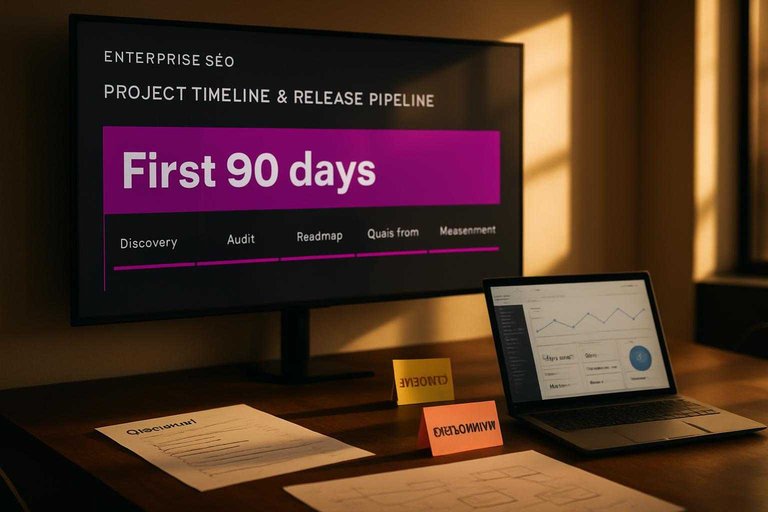
First 90 days
Early wins usually come from clarity, not heroics. These deliverables tend to show up first because they unblock everyone else.
- Technical and content audit, scoped to key templates
- Prioritized roadmap with owners and dependencies
- Quick fixes: indexation, redirects, canonicals, internal links
- Measurement setup: dashboards, annotations, baselines
- Training for writers, PMs, and engineers
If you can’t name owners for the roadmap, momentum will stall regardless of who “found” the issues.
Handoff risks
Speed can be fake if it depends on one person or one vendor. The failure modes look boring, then become expensive.
- Ownership unclear between SEO, eng, and content
- Vendor becomes the only operator of the system
- Recommendations pile up with no execution path
- Internal teams “agree,” then never schedule work
- Knowledge stays in docs, not habits
If delivery requires constant chasing, you don’t have a speed problem. You have a governance problem.
Acceleration signals
Scaling shows up as shorter loops between insight and release. You’ll feel it in fewer meetings, fewer reversals, and cleaner decision paths.
Look for signals like faster deploys, fewer reworks from late-stage QA, clearer prioritization across teams, and repeatable outputs like templates, checklists, and briefing formats.
When the work becomes routine, you’ve earned momentum—and you can start increasing ambition safely.
Capability Breadth
You scale faster when every required skill shows up at the right time. Breadth matters because enterprise SEO is rarely one discipline; it’s a dependency chain.
A quick way to compare coverage is to map who can do what without handoffs. In practice, this is where tooling can quietly expand your coverage—e.g., a platform like Skribra can shoulder a meaningful slice of Content SEO execution (SEO-optimized drafts with keywords, meta descriptions, and formatting, plus WordPress publishing) so content throughput isn’t always gated by agency bandwidth or internal production queues. If you need a baseline for what “good” looks like across the funnel, see this practical SEO guide overview.
| Capability area | In-house team | Enterprise SEO agency | Watch-out |
|---|---|---|---|
| Technical SEO | Deep platform context | Broad pattern library | Release bottlenecks |
| Content SEO | Brand voice control | Production systems | Approval latency |
| Digital PR | Hard to staff | Existing relationships | Off-brand links |
| Analytics & measurement | Internal data access | Reporting frameworks | KPI misalignment |
| International SEO | Local nuance needed | Market playbooks | Translation drift |
If three boxes rely on “someone else,” you’re not scaling; you’re queueing.
Cost and Resourcing
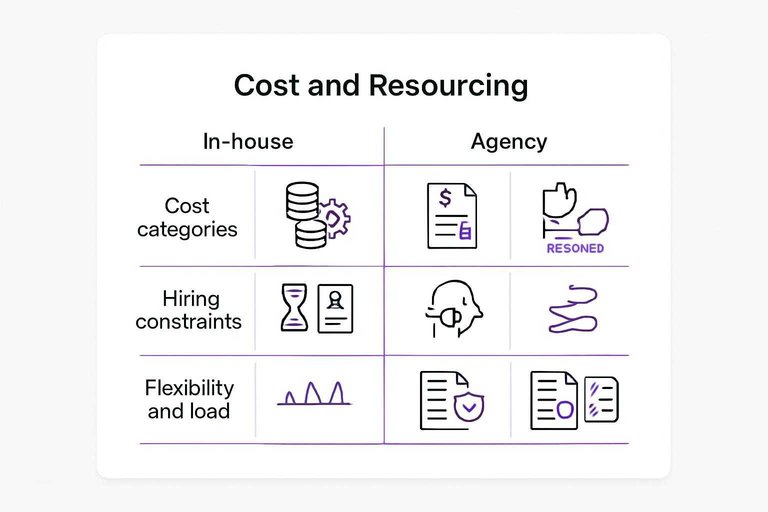
You scale SEO with people, tools, and time. The cost question is really about total ownership and how fast you can reallocate capacity when priorities shift.
Cost categories
Costs hide in different buckets depending on where the work sits. Map them before you compare a retainer to a headcount.
- Agency retainer and change requests
- Specialist contractors for gaps
- Salaries, benefits, and backfill
- Tools, data, and content systems
- Training, process, and management overhead
If you only price the obvious line item, you will underfund the bottleneck.
Hiring constraints
In-house scaling often hinges on hiring, not strategy. Senior SEO roles are scarce because they need technical depth and political fluency.
Time-to-hire stretches when you need a specific mix of skills, like JavaScript SEO plus analytics. Leveling gets messy too, since “SEO lead” can mean wildly different scopes.
If you cannot define the role crisply, you will hire slowly and manage painfully.
Flexibility and load
Agency capacity is elastic when you hit spikes, like migrations or international rollouts. In-house bandwidth is fixed, and peaks collide with vacations, approvals, and other roadmap work.
That makes planning the real cost center: you either pre-staff for peaks or accept slower delivery. Agencies can often shift specialists across accounts, while your team cannot.
If your demand curve is lumpy, fixed staffing will feel like failure even when it is normal.
Procurement realities
Enterprise procurement can slow down “fast” decisions. Budget holders often underestimate the time between selecting a vendor and starting work.
- Vendor onboarding and compliance intake
- Master service agreements and legal redlines
- Security reviews and access approvals
- Renewal cycles and re-justification
If procurement takes longer than hiring, speed becomes a governance problem, not an SEO problem.
Governance and Risk
Scaling SEO in a large company is mostly a governance problem. The work is easy; safe, compliant change is hard.
Compliance guardrails
Regulated industries scale SEO through pre-approved language, documented reviews, and clear ownership. The goal is simple: publish fast without creating legal, accessibility, or disclosure risk.
Approvals often follow a few predictable lanes:
- Claims control: approved phrases for outcomes, comparisons, and “best” language
- Disclosure rules: required footers, affiliate notes, and jurisdiction-specific disclaimers
- Accessibility checks: alt text standards, heading structure, contrast, and form labels
- Evidence storage: where substantiation lives, and who can update it
If your SEO process cannot show “who approved what, and why,” it will not scale in regulated markets.
Brand and quality
Brand consistency is what keeps scale from turning into noise. You need controls that make good work the default.
- Editorial guidelines for voice, tone, and claims
- Page templates with locked brand components
- QA checklists for SEO, UX, and accessibility
- Review workflows with clear approvers
- Content inventories and refresh cadences
The winning system reduces judgment calls, so publishing stays fast under pressure.
To anchor quality work in durable fundamentals, reference the SEO Starter Guide basics.
Security and access
Enterprise SEO needs deep visibility, but not broad permission. The goal is to unblock analysis while limiting blast radius.
In-house teams often get direct access to Search Console, analytics, CMS roles, and log files. Agencies can do the same, but only if you set strict least-privilege rules:
- Separate accounts per person, never shared logins
- Read-only by default for analytics and Search Console
- Time-bound, ticketed elevation for CMS changes
- Centralized logging for exports and API keys
If someone needs admin to “do SEO,” your access model is the real bottleneck.
For role-based controls, see Search Console permissions.
Change management
Technical SEO changes touch critical systems, so your release process matters more than your ideas.
- Write a change brief with scope, owners, and success signals.
- Run impact review with SEO, engineering, legal, and brand as needed.
- Ship behind a flag, or to a small cohort, with monitoring in place.
- Document rollback steps and thresholds before the first deploy.
- Capture what changed, where, and who signed off.
The model that scales faster is the one with repeatable releases, not heroic pushes.
For safe experimentation patterns, follow A/B testing best practices for Search.
Collaboration Model
Scaling SEO is mostly a collaboration problem. The faster option is the one that plugs into your existing operating system without constant translation.
Engineering interface
SEO work lives or dies in the backlog, not in audits.
In-house teams usually write tickets in the same system engineering already uses, join sprint planning, and negotiate scope in real time. Agencies often bring a structured intake and clear acceptance criteria, but they can struggle when requirements depend on codebase context, feature flags, or internal release rules.
A practical split looks like this: in-house owns the “how” in your stack, while an agency standardizes the “what” across many sites and patterns. Speed comes from fewer handoffs, not more recommendations.
Content at scale
At scale, content is operations, not writing.
In-house teams tend to win on subject-matter access, because they can pull product, support, and sales into the workflow. Agencies tend to win on editorial throughput, because they can staff roles like editors, strategists, and producers without waiting on headcount.
Localization is where the model shows. In-house can set one global standard and enforce it with product naming, legal reviews, and brand rules, while agencies can run repeatable briefs and QA checklists market by market.
If content is your bottleneck, borrow capacity. If expertise is your bottleneck, build proximity.
Stakeholder alignment
Alignment is a calendar and a paper trail. Without both, scaling turns into endless re-litigation.
- Weekly triage with owners and SLA
- Monthly OKR check-in with deltas
- Quarterly QBR with decisions recorded
- Rolling roadmap with dependency tags
- Decision log with reversals tracked
If you can’t point to the decision log, you don’t have alignment. You have vibes.
Global coordination
Multi-market SEO breaks when everyone “does their own thing.” It also breaks when no one is allowed to adapt.
In-house models usually centralize governance: a single hreflang standard, one URL policy, one template strategy, and shared QA gates before launches. Agencies can run coordination across regions with playbooks and audits, but they need clear authority lines or they end up negotiating the same basics in every market.
The clean approach is “central rules, local execution.” Give regions autonomy on content and intent, while the center owns architecture, tagging, and hreflang hygiene.
Choose Your Scaling Path—and Make It Operational
- Define “scale” for your org in one sentence (coverage, velocity, quality, or cross-team throughput) and pick 2–3 metrics you’ll use to judge it.
- Stress-test both models against your constraints: access/security, engineering bandwidth, content production, procurement speed, and stakeholder alignment.
- Decide with a bias toward the bottleneck: choose an agency when execution capacity and specialized breadth are the limiter; choose in-house when context, governance, and cross-functional influence are the limiter.
- Whatever you pick, lock the collaboration model early—intake rules, cadence, decision owners, and handoff points—so “scaling” doesn’t turn into more work without more progress.
Frequently Asked Questions
- What’s the best enterprise SEO KPI set to track when you’re scaling across hundreds or thousands of pages?
- Track a mix of coverage, quality, and business impact: indexation and crawl efficiency, non-branded organic traffic, conversions/revenue from organic, and issue backlog velocity (how fast critical SEO tickets get shipped). Use Google Search Console, GA4, and your crawl platform to keep a single view by template, directory, and market.
- Can an enterprise SEO agency and an in-house enterprise SEO team work together without duplicating work?
- Yes—set clear ownership by workstream (e.g., in-house owns strategy and stakeholder alignment; agency owns technical audits, content ops, or digital PR) and run a shared backlog with a RACI and weekly triage. The goal is one roadmap, one set of definitions, and one reporting layer.
- Should enterprise SEO live under marketing, product, or engineering in a large organization?
- Most enterprise SEO scales best when it has marketing leadership for priorities and messaging, plus a formal operating cadence with product/engineering for implementation. Put decision rights and SLAs in writing so SEO changes don’t get stuck behind competing roadmaps.
- What’s the biggest reason enterprise SEO programs stall after the first technical fixes?
- They stall when there’s no repeatable operating system: a prioritized backlog, clear ticket templates, owners per template/site section, and a release process that validates SEO impact. Without that, fixes become one-off projects instead of a compounding program.
- How do you scale enterprise SEO content production without creating duplicate or low-quality pages?
- Use strict content governance: keyword-to-page mapping, template rules, editorial QA, and uniqueness checks before publishing, then monitor performance and prune or consolidate underperformers. If you need a steady workflow, a platform like Skribra can help generate SEO-structured drafts and publish via WordPress while you keep humans in the loop for approvals and brand compliance.
Scale Enterprise SEO Output
Whether you choose an agency, in-house, or a hybrid model, the real bottleneck is consistently publishing optimized content with reliable governance and speed.
Skribra helps enterprise SEO teams accelerate momentum with daily, SEO-optimized articles, WordPress publishing, and built-in backlink exchange—start with a 3-Day Free Trial.
Written by
Skribra
This article was crafted with AI-powered content generation. Skribra creates SEO-optimized articles that rank.
Share: