June 15, 2026
·
10 min read
Weekly SEO in Agencies: Limits and Trade-offs
A case study on the realities of running “weekly SEO” inside agencies—how cadence affects strategy, dependencies, quality, and measurement lag so you can choose deliverables that create real momentum instead of busywork.

Weekly SEO sounds clean on paper: a predictable rhythm, clear accountability, and a steady stream of updates you can show a client every Friday. In an agency, it also quietly reshapes how you plan, what you prioritize, and how much of the work becomes coordination instead of outcomes.
This case study walks through what “weekly” really implies, where it breaks, and which work types actually fit the cadence. You’ll also see a realistic week-by-week flow, scoping rules that prevent thrash, and how to handle the uncomfortable truth of measurement lag.
Agency Week Reality
Weekly SEO is appealing in agencies because it feels controlled. You can promise a cadence, show activity, and keep momentum across accounts. Then reality hits fast: approvals slow work, access blocks execution, and client context resets every call.
Why weekly sells
Weekly cadence sells because it matches how agencies operate. It creates a clean story for clients and a clean process for your team.
- Package work into repeatable deliverables
- Report progress without heavy interpretation
- Align effort with retainer billing cycles
- Keep stakeholders engaged with regular touchpoints
- Reduce fear of “nothing happened”
Weekly is less about SEO mechanics, and more about expectation management.
What weekly implies
“Weekly SEO” is never just doing tasks. It’s a full loop of deciding, shipping, checking, and explaining.
Execution includes planning, implementation, QA, stakeholder sync, and the waiting period before signals change. That waiting period is the part nobody can schedule.
If you promise weekly, you’re also promising weekly coordination.
Hidden weekly costs
A weekly rhythm creates overhead even when the work is simple. The machine around the work can take more time than the work.
- Standing calls and follow-up threads
- Ticket creation, grooming, and status chasing
- Documentation for handoffs and approvals
- Access requests and permission audits
- Dependency coordination with dev and content
If half your week is logistics, your roadmap becomes whatever clears fastest.
Cadence vs impact
SEO rarely rewards a neat seven-day feedback loop. Rankings, crawling, indexing, and internal adoption move on their own timelines.
That mismatch creates pressure to ship visible work weekly, even when the best move is foundational. Technical cleanup, information architecture, and measurement fixes often look “slow” right before they pay off.
When weekly optics drive decisions, you’ll optimize for motion, not leverage.
Where It Breaks
Weekly cadence can work when foundations are solid and dependencies are light. Agencies usually hit failure modes when the system is still forming, yet delivery pressure stays fixed.
Strategy thrash
Weekly pivots feel responsive, but they splinter your roadmap. Each new “priority” resets learning loops, so you stop compounding insights.
A page gets rewritten before it ranks, internal links change before crawlers reprocess, and experiments end before signals stabilize. The backlog turns into unrelated tasks: a title tweak here, a blog draft there, a random schema ticket somewhere else.
The real cost is opportunity loss. You trade a coherent bet for perpetual motion.
Dependency pileups
Weekly plans collapse when someone else holds the keys. SEO touches systems you don’t control, and those queues rarely run weekly.
- Development queue exceeds SEO cadence
- Brand or legal review delays publishing
- CMS blocks templates or redirects
- Analytics access slows measurement
- Stakeholders miss approvals or inputs
If two or more show up at once, you’re not “behind.” You’re dependency-bound.
Quality erosion
Weekly shipping pushes you toward smallest-possible changes. That’s fine for hygiene, but it breaks when you need architectural work.
QA gets squeezed first. Then information architecture decisions get deferred, so you patch navigation with more internal links and hope.
Technical debt is the interest you pay later. It shows up as fragile templates, inconsistent taxonomy, and fixes that keep re-breaking.
Reporting theater
Weekly reporting can turn into a performance of motion. You highlight tasks shipped and micro-metrics that move easily.
Rank screenshots, “pages optimized,” and minor CTR bumps become the story, even if crawlability, indexation, and content focus are drifting. The team gets rewarded for busyness, not for a healthier SEO system.
Ask one harder question each week: did our constraints shrink, or did we just decorate them?
To reduce the temptation to optimize for optics, it helps to standardize and simplify the work system with resources to simplify SEO workflows.
To keep expectations grounded, it helps to remember that improvements may take time to show even after you ship changes.
Work Types by Cadence
Weekly cycles feel efficient because they ship something visible. They also tempt you into thin work that never compounds.
You need a cadence map that protects deep work while still feeding weekly reporting—especially if you’re trying to unlock daily SEO gains with AI without turning everything into reactive micro-tasks.
| Work type | Fits weekly cadence | Needs multi-week arc | Risk if forced weekly |
|---|---|---|---|
| Title/meta refresh | Yes | No | Over-tweaking noise |
| Internal link updates | Yes | Sometimes | Random link sprawl |
| Content briefs | Sometimes | Yes | Shallow research |
| Technical fixes | Sometimes | Yes | Half-fixed regressions |
| Information architecture | No | Yes | Permanent mess |
Plan weekly deliverables as inputs to longer arcs, not replacements. That’s how you avoid shipping busywork with a KPI label.

A Real Agency Week
One client. One weekly SEO slot. Enough time to move things, but not enough to do everything.
Imagine a B2B site with a small backlog: a few decaying pages, a crawl quirk, and a product team shipping updates.
Monday triage
You start with messy inputs and limited hours. The goal is one meaningful outcome, not ten small gestures.
- Scan Search Console, crawl notes, and recent releases for obvious breakpoints.
- List every request, then tag each as impact, urgency, and effort.
- Pick one outcome you can ship by Thursday without heroics.
- Cut or defer anything needing cross-team approvals or new design.
- Write the week plan in three bullets and send it.
Time pressure doesn’t reduce scope politely. It forces a choice.
Midweek execution
Execution is a mix of shipping and unblocking. You do what fits the window, and you avoid work that stalls in review.
You refresh two high-intent pages with clearer titles, tighter intros, and FAQs pulled from sales calls. You fix a templated canonical issue affecting a subset of filtered URLs, because it’s isolated and testable. You add internal links from a few strong pages to one priority page, since links don’t require a rewrite. You also ping the developer once, with one screenshot, because five pings become nobody’s job.
The trade-off is real: you ship improvements that compound, and you leave the big rewrite for a week with real stakeholder time.
Friday reporting
Weekly reporting should focus on what you changed and what you decided. Rankings move slowly, but decisions happen fast.
- Decisions made and why
- Changes shipped and where
- Risks discovered and impact
- Dependencies and owners
- Next-week plan and blockers
If you can’t point to a shipped change or a cleared dependency, the week was mostly churn.
For clarity on what’s actually measurable (and why shorter windows can be noisy), use the Search Console Performance report metrics as your baseline.
Lessons learned
Leverage came from choosing one page and one technical fix that touched many URLs. Churn came from half-starting tasks that needed approvals.
Next cycle, you pre-book review time on Monday and keep a “no-approval” backlog for short weeks. You also track decisions as deliverables, because they prevent reruns of the same debate.
Weekly SEO works best when your process protects shipping from consensus.
Choosing Weekly Deliverables
Weekly SEO deliverables can either compound quietly or burn hours loudly. Your job is to pick work that protects the roadmap and still shows momentum.
Imagine a three-month technical initiative running in parallel with weekly asks. The right weekly deliverables remove friction for that initiative, instead of competing with it. For many teams, that means standardizing a repeatable content cadence—especially when a platform like Skribra can handle consistent, SEO-structured publishing while you keep engineering and technical SEO focused on the longer arc.
High-leverage signals
Weekly work should create assets you reuse, not artifacts you file away. Look for signals that the output will scale across pages and weeks.
- Produces reusable templates and checklists
- Expands internal links via repeatable rules
- Improves instrumentation and alerting
- Clears a top-three blocker fast
- Unlocks other teams’ queued work
If it doesn’t unlock future work, it’s probably weekly theater. The same test applies to content ops: a workflow that repeatedly produces properly formatted drafts (keywords, meta descriptions, consistent structure) and publishes with minimal handoffs tends to compound far more than one-off “perfect” pages.
Avoiding vanity tasks
Some tasks look “SEO-ish” but rarely move the system. They consume a week and leave nothing sturdier behind.
- Swapping keywords without intent change
- Tweaking copy on already-strong pages
- Chasing single-page score improvements
- Publishing one-off content with no distribution
- Renaming titles to match a tool suggestion
If the user journey stays identical, your impact probably does too. Similarly, spinning up isolated blog posts without a scalable production and publishing loop often becomes busywork; it’s usually better to invest in a cadence you can maintain (including tooling that reduces manual formatting and upload steps).
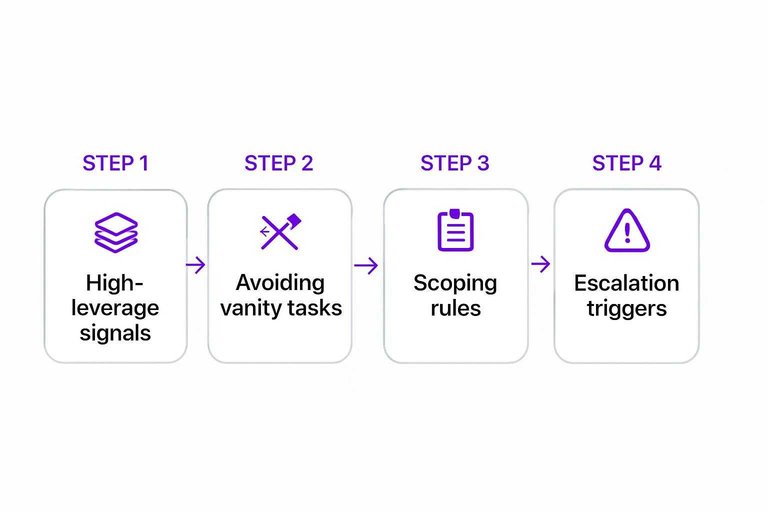
Scoping rules
Weekly delivery needs guardrails, or everything becomes half-done forever. Use simple rules that force clarity and reduce context switching.
- Define “done” in one sentence before work starts.
- Cap work-in-progress to protect focus.
- Assign a named owner for every dependency.
- Batch reviews and approvals into fixed windows.
- Stop the week if “done” becomes untrue.
Scope discipline is how you ship weekly without killing the quarter. If content is part of the weekly output, “done” can also include publish-ready requirements (on-page basics, metadata, formatting) so production doesn’t stall at the last mile—especially when your workflow supports direct publishing and automation rather than manual handoffs.
Escalation triggers
Weekly production is fragile when the foundation is unstable. When the same issues repeat, pause output and escalate the constraint.
Repeated blockers, unreliable tracking, or accumulating technical debt are escalation signals. They turn weekly deliverables into guesswork.
Escalate early and you buy back every future week. In content programs, the equivalent is a brittle publishing pipeline—if drafts routinely get stuck in formatting, missing metadata, or inconsistent SEO basics, that’s a constraint worth fixing (often with clearer standards and more automated production) before you judge the strategy on results.
Measurement Lag Reality
Weekly SEO reporting tempts you to treat rankings like a heartbeat monitor. They’re not.
Most week-to-week movement is noise from crawling, reprocessing, competitors, and SERP layout shifts. If you judge execution by weekly rank swings, you’ll reward thrash and punish steady work.
What changes weekly
Weekly tracking should focus on leading indicators you can actually influence on a short cadence.
They show whether the machine is running, not whether the market has reacted yet.
- Crawl errors and response codes
- Indexation events and coverage shifts
- Content shipped and updated URLs
- Internal link coverage to targets
- Backlog burn-down and blockers
Treat these as control-panel gauges, not trophies.
What must wait
Rankings, conversions, and revenue are lagging indicators. They depend on recrawling, reindexing, re-ranking, and user behavior catching up.
A page can be “right” for weeks before it earns stable impressions, clicks, and attribution. Longer windows also smooth out seasonality, SERP volatility, and tracking quirks.
Build patience into the plan, or you’ll end up chasing ghosts.
Instrumentation first
Set up tracking so weekly updates are about facts, not vibes.
- Segment GSC by query type and page groups.
- Add annotations for every release, migration, or template change.
- Log each SEO change with URL-level detail.
- Split brand vs non-brand in every view.
- Save a weekly snapshot of key reports.
If you can’t explain a change, you can’t learn from it.
Decision checkpoints
Weekly check-ins should steer execution, not judge outcomes.
Pick 4–6 week checkpoints to evaluate whether the strategy is working, using stable windows and comparable cohorts.
If you don’t schedule those moments, weekly reporting becomes a hamster wheel with better charts.
Make “Weekly” Serve the Strategy, Not the Other Way Around
- Define “weekly” in writing: what ships every week, what’s reviewed weekly, and what runs on a longer cycle.
- Pick weekly deliverables that reduce uncertainty (technical fixes, instrumentation, prioritization, unblockers) and avoid vanity tasks that exist only to fill a status update.
- Add scoping rules and escalation triggers: when dependencies, approvals, or quality risk push an item out of the week, you rescope instead of thrashing.
- Separate activity reporting from decision checkpoints: track inputs weekly, but schedule outcome decisions around the lag of SEO signals so Friday doesn’t turn into theater.
Turn Weekly SEO Into Momentum
Weekly SEO deliverables are easy to promise but hard to sustain when measurement lags and agency weeks fill up with reactive work.
Skribra keeps output consistent with daily, SEO-optimized articles, WordPress publishing, and built-in backlink support—so weekly plans actually compound. Try the 3-Day Free Trial to see it in your workflow.
Written by
Skribra
This article was crafted with AI-powered content generation. Skribra creates SEO-optimized articles that rank.
Share: