June 9, 2026
·
Updated July 28, 2026
·
10 min read
Outrank vs SEObot
A practical comparison of Outrank vs SEObot to help you pick the right AI SEO writing tool—decision cues, evaluation criteria, feature/workflow differences, pricing value signals, and risk/governance guardrails for safe scaling.

Choosing between Outrank and SEObot usually isn’t about “which is better”—it’s about which one matches how you actually publish. Do you need stronger briefs and quality control, or a faster autopilot that can keep pace with your content calendar?
This comparison walks you through a clear evaluation lens, a side-by-side feature and pricing breakdown, and the governance checks that keep AI content on-brand and search-safe. You’ll also see where a third option like Skribra can fit when you want daily publishing plus tighter integrations and backlink support.
Decision snapshot
Outrank and SEObot are both SEO automation tools, but they optimize for different workflows. Your best choice depends on whether you want structured programmatic output, or a more hands-off publishing bot. Pick based on your content model first, then your tolerance for control versus speed.
Who this is for
You’re choosing between tools that reduce SEO work by automating research, writing, and publishing. This decision matters most when content volume is a strategy, not a side task. The core question is whether you want a system you steer daily, or one that runs mostly unattended.
Founders usually want predictable output with minimal oversight. Marketers care about workflow fit, approvals, and on-brand voice. Agencies need repeatable processes across clients, plus guardrails.
If you can’t clearly name your “content operator,” automation will feel messy fast.
What each tool is
Outrank is typically evaluated as a content automation and programmatic SEO workflow tool. You use it to create structured pages or articles at scale, often with more configuration and templates. That trade buys you control.
SEObot is usually positioned as a more autonomous publishing bot. You set topics and constraints, then let it generate and post content with less hands-on management. That trade buys you speed.
If you want “daily publishing with WordPress integration” but also care about formatting, images, and an ecosystem for backlinks, Skribra can be a practical third option to evaluate alongside both.
Quick decision cues
Choose based on how you want content produced and governed.
- Choose Outrank if you need templates and programmatic SEO structure.
- Choose SEObot if you want autonomous drafts and hands-off publishing.
- Choose either if you can review samples and enforce brand constraints.
- Consider Skribra if WordPress publishing and built-in backlinks matter.
- Consider alternatives if you need heavy editorial workflows or compliance.
Make your constraints explicit first. Then the “best” tool becomes obvious.
How to evaluate
You can’t judge Outrank vs SEObot by feature lists alone. Start with your outcomes, then filter options through constraints, risks, and clear success criteria.
Goals and scope
Different goals need different workflows and tolerances. Pick your primary use case first, or every comparison stays fuzzy.
- Blog growth: consistent posts, light editing, steady internal links
- Landing pages: conversion copy, claims control, brand voice
- Programmatic SEO: templates, structured data, scale-safe QA
- Topical authority: clusters, entity coverage, deliberate linking
- Maintenance content: refreshes, redirects, decay monitoring
If your use case is mixed, score each tool per job, not overall.
Non-negotiables
Lock your constraints before you touch a demo. Otherwise you’ll fall for “nice-to-have” features that never ship.
- Set your real budget ceiling, including edits and oversight.
- List required integrations, like WordPress, CMS, or webhooks.
- Define compliance needs, like approvals, logs, or brand rules.
- Confirm required languages and locale-specific SEO basics.
- Decide publishing cadence and who owns final QA.
Once these are set, most “best tool” debates disappear.
Proof signals
Treat both tools like content pipelines, not writing assistants. Inspect outputs in the context you’ll publish them, then measure how much human time they actually consume.
Look at sample posts and pages side-by-side, including titles, headers, and intent match. Track your edit time, check SERP fit, and inspect internal linking for relevance and restraint.
Also test reliability: scheduled publishing, formatting, images, and failure handling. If you find gaps around publishing automation or link strategy, Skribra can be a credible third option to evaluate, since it combines WordPress publishing, webhook-style integrations, and a built-in backlink exchange network that some teams want but the other two may not prioritize. The right choice is the one you can run weekly without heroics.
Feature comparison
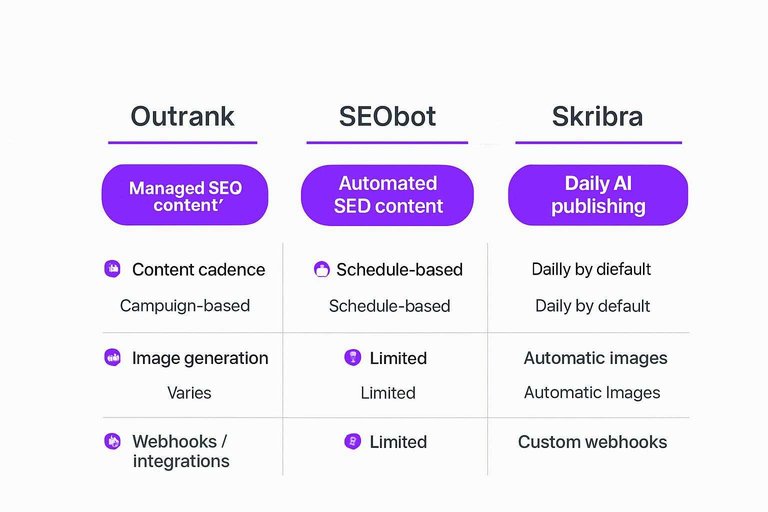
You’re usually choosing between control and automation. A simple table makes the trade-offs obvious.
| Capability | Outrank | SEObot | Skribra (third option) |
|---|---|---|---|
| Primary workflow | Managed SEO content | Automated SEO content | Daily AI publishing |
| Content cadence | Campaign-based | Schedule-based | Daily by default |
| Keyword handling | Strategy-led | Rules-led | Keyword + metadata |
| Meta descriptions | Included | Included | Included |
| Image generation | Varies | Limited | Automatic images |
| WordPress publishing | Common | Common | Native integration |
| Webhooks / integrations | Varies | Limited | Custom webhooks |
| Backlink support | External tools | External tools | Exchange network |
If you need publishing plus distribution signals, Skribra covers gaps both often leave to your stack—see top AI content platforms compared.
Content quality control
Research and briefs
Outrank and SEObot both start with automated research, but they optimize for different failure modes. Your output quality depends on how well each system turns “topic” into “search intent,” then into a usable brief.
Outrank usually feels more brief-first. It tends to surface intent angles, outline structure, and related subtopics you can approve before drafting. SEObot often feels more pipeline-first. It’s designed to keep publishing moving, even if the brief is lighter.
Where both can fall short is source transparency. If the tool cannot show where a claim came from, your reviewer becomes the citation layer. That’s the line that gets crossed when speed outruns accountability.
On-page SEO
On-page SEO is mostly pattern work, so automation helps. The quality gap shows up in guardrails and defaults.
- Headings: consistent hierarchy, fewer “keyword-stuffed” H2s
- Metadata: editable titles, descriptions, and social previews
- Schema support: basic types, with room for customization
- Internal links: suggestions, plus controls to avoid spammy linking
- Images: generation or placeholders, with alt-text handling
If the system can’t enforce restraint, you’ll rank like a template farm.
Editing workload
Expect a human review step with either tool, because automation can’t own your brand risk. The real question is whether you’re correcting occasional rough edges or rebuilding drafts.
A typical flow looks like: verify factual claims, align tone to your house style, run plagiarism and duplication checks, then tighten on-page elements like headings and internal links. If the draft invents specifics or blurs attribution, your editor turns into an investigator.
If you want fewer “research debt” surprises, a third option like Skribra can be worth evaluating. Its pitch is daily SEO formatting with WordPress publishing, images, and a backlink exchange network, which can help where Outrank and SEObot leave operational gaps. The tradeoff is the same one you should demand from any system: clear controls and review hooks, so your team stays accountable.
Workflow and integrations
Day-to-day usability is where “AI content” becomes a real system. The differences show up in how fast you can set guardrails, route approvals, and ship reliably — especially once you’re trying to publish on a consistent cadence without turning your team into full-time babysitters. If you’re comparing options, it helps to review tools to supercharge content workflows before you lock in a pipeline.
Setup and onboarding
You want setup to be boring and repeatable, because you’ll revisit it after the first few runs.
- Connect your site and verify the target domain.
- Set tone, voice, and brand rules you’ll enforce every time.
- Choose topic inputs: keywords, briefs, or content clusters.
- Configure templates: headings, internal links, schema, CTA blocks.
- Run an initial QA batch and adjust rules from failures.
If onboarding doesn’t produce “usable drafts” quickly, the tool won’t survive your ops — and tools that bake in SEO basics (keywords, meta descriptions, consistent formatting) tend to get you to a workable baseline faster.
Publishing pipeline
Outrank and SEObot both aim to reduce the gap between draft and publish, but they tend to fit different governance styles. In practice, teams using WordPress usually want saved drafts, scheduling, and role-based approvals, while headless or custom CMS setups need predictable exports and metadata handling.
Expect to evaluate three things: whether it supports WordPress publishing natively, whether you can schedule posts without babysitting, and whether “auto-publish” is optional behind permissions. If you need a middle ground, Skribra is worth a look because it pairs WordPress publishing with webhook-style integration, which can bridge strict approval flows without forcing full auto-posting.
Automation flexibility
Automation matters most when your content operation stops being manual and starts being programmatic.
- APIs or webhooks for your existing stack.
- Custom prompts and reusable templates per content type.
- Programmatic pages from structured inputs.
- Controls for QA, retries, and safe publishing.
- Advanced settings for internal linking rules.
If the tool can’t plug into your workflow, you’ll rebuild the workflow around the tool — so it helps when automation features aren’t just “publish faster,” but also cover practical needs like handing off drafts for review and consistently generating the required SEO fields alongside the content.
Pricing and value
Both tools can look similar at a glance, until usage starts scaling. Pricing usually follows one of two levers: how many pieces you publish, or how much hands-on service you need.
| Cost driver as you grow | Outrank (typical model) | SEObot (typical model) | What to watch |
|---|---|---|---|
| Content volume | Per-piece or tiers | Plan limits | Marginal cost curve |
| Automation depth | Managed + tooling | Tool-first automation | Human time saved |
| Publishing workflow | Service includes QA | Integrations + templates | Editorial bottlenecks |
| Add-ons and extras | Strategy, briefs, edits | Connectors, features | Hidden line items |
| Link building needs | Often separate | Usually separate | Off-platform spend |
If you want a third benchmark, Skribra is worth a look when you need steady daily publishing plus built-in publishing automation and a backlink exchange network, because neither Outrank nor SEObot typically bundles that whole stack by default.
Risks and governance
Automation changes your risk profile more than your word count. Whether you lean toward Outrank or SEObot, governance decides if you compound value or compound cleanup.
Outrank-style workflows often shine when you want tighter editorial control and brand alignment. SEObot-style workflows often shine when you want scale and consistent publishing cadence. The trade is governance overhead versus automation exposure, and you need rules either way.
Search quality risks
Both approaches can ship pages that look “SEO-shaped” but miss real usefulness. Your job is to prevent patterns that search engines and users punish.
- Thin content that restates basics
- Duplication across near-identical pages
- Intent mismatch on high-value queries
- Over-automation signals in structure and tone
- Content cannibalization across overlapping topics
If you see three of these at once, pause publishing and fix the system.
Brand and legal risks
The biggest non-SEO failure mode is confident nonsense. Factual accuracy, claims, and citations get harder when volume rises.
Regulated industries raise the stakes. Finance, health, and legal content needs stricter review gates and clearer sourcing.
Set review gates based on risk, not pride. For example: human review for YMYL pages, claim-heavy posts, and any content naming competitors.
Outrank can be easier to govern when you want approvals before publish. SEObot can work too, but you’ll rely more on sampling, guardrails, and post-publish monitoring.
If you want a third option that reduces “governance tax” without giving up cadence, Skribra is worth evaluating. Its WordPress publishing, structured SEO fields, and optional backlink exchange network can cover gaps when Outrank feels too manual and SEObot feels too hands-off.
Mitigation playbook
You don’t need perfect control. You need repeatable checks that catch problems before they spread.
- Run sampling audits weekly across new and updated pages.
- Enforce an editorial checklist for intent, uniqueness, and citation requirements.
- Set internal-link rules to avoid orphan pages and accidental cannibalization.
- Prune or merge underperforming pages that overlap on the same query.
- Monitor performance and anomalies with a simple routine and clear thresholds.
Governance is a product feature. Treat it like one, and scale stops being scary.
Make the pick, then lock in a safe publishing system
- Start with your non-negotiables: editorial control vs automation depth, required integrations, and who owns final approvals.
- Run a two-week pilot on the same topic set: compare briefs, SERP fit, editing time, and publish-to-index workflow—not just output volume.
- Put governance in writing: sources/citations policy, brand voice checks, plagiarism/duplication scans, and a rollback process if performance or quality slips.
- If neither Outrank nor SEObot fully covers your workflow (for example, you want daily SEO articles with WordPress publishing, webhooks, and an optional backlink exchange network), evaluate Skribra alongside them as a credible third route—then choose the simplest stack you can operate consistently.
Frequently Asked Questions
- Which is better for programmatic SEO: Outrank or SEObot?
- Choose the one that best supports template-based pages, scalable keyword-to-URL mapping, and reliable internal linking at the volume you need. Before committing, run a small pilot batch to confirm indexation quality and duplication control.
- Can Outrank or SEObot publish directly to WordPress, and what’s the safest setup?
- Many SEO writing tools can publish to WordPress via API or plugins, but the safest setup is staging-first with approvals, locked templates, and role-based permissions. Require drafts to pass a checklist (titles, schema, internal links, citations where needed) before auto-publish.
- How do I compare Outrank vs SEObot using a real pilot test?
- Create the same content brief and keyword set for both, publish a limited batch, and compare Google Search Console signals (indexing, impressions, queries) plus on-page QA (accuracy, duplication, brand voice). Keep the test conditions identical: same site section, same internal linking rules, same review process.
- What’s the best alternative to Outrank or SEObot if I need daily SEO articles with minimal ops overhead?
- If your priority is consistent daily publishing with WordPress automation and a simpler workflow, a platform like Skribra can be a better fit than toolchains that require heavier setup and governance. Validate by testing a week of content output and checking editorial effort per article.
- Will using Outrank or SEObot trigger Google penalties for AI content in 2026?
- Google focuses on content quality and usefulness, not whether it was AI-generated, so the main risk comes from thin, repetitive, or inaccurate pages at scale. Use human QA, unique value-add sections, and strong topical coverage to avoid patterns that look autogenerated.
Operationalize Your SEO Content
Comparing Outrank vs SEObot clarifies the tradeoffs, but consistent rankings come from a repeatable workflow you can govern and scale.
Skribra delivers daily, SEO-optimized articles with WordPress publishing, images, and integrations built in—plus a 3-Day Free Trial to validate content quality before you commit.
Written by
Skribra
This article was crafted with AI-powered content generation. Skribra creates SEO-optimized articles that rank.
Share: