August 24, 2026
·
13 min read
Outrank vs. Skribra for Autopilot SEO Content Publishing
A side-by-side comparison of Outrank vs. Skribra for autopilot SEO publishing—how “autopilot” really works, what each tool automates (keywords, on-page SEO, images, publishing, backlinks), how integrations and governance affect quality, and how pricing/scale trade-offs shape the right pick.

“Autopilot SEO” sounds like you flip a switch and new pages appear—well-targeted, correctly formatted, and published without babysitting. In reality, the difference between tools is where automation stops: keyword choices, on-page packaging, media, CMS publishing, and the guardrails that keep quality from drifting.
This comparison walks you through the workflow match, integrations and extensibility, pricing/packaging, and content governance—so you can choose the setup that fits your site, your review tolerance, and how much control you need as you scale.
Decision Snapshot
“Autopilot” SEO publishing sounds simple until you define the workflow end-to-end. Outrank and Skribra can both get you to “articles published,” but different constraints pick different winners.
What “autopilot” means
Autopilot means the whole loop runs without you: keywords picked, article written, on-page SEO applied, images added, then published. If you still copy-paste drafts, chase meta descriptions, or upload images by hand, you are not on autopilot.
In practice, a real autopilot workflow includes:
- Keyword research and topic selection
- Draft generation with headings and formatting
- Title tag and meta description output
- In-article images generated and inserted
- CMS publishing to draft, scheduled, or live
The only human step should be deciding how much control you want to keep.
How we judge winners
You need criteria that match your operating style, not just feature lists.
- Content quality controls and review options
- SEO tooling depth, including keyword research
- Publishing automation to your CMS
- Integrations and extensibility, including webhooks
- Scalability and predictable total cost
If your criteria change, the “best” platform changes with them.
Who this is for
This is for founders, marketers, and agencies who want consistent publishing without living in an editorial queue. You want fewer moving parts, fewer handoffs, and fewer “we’ll publish later” promises.
If you already have editors and a complex brief process, you are buying a different tool category. Autopilot platforms are for momentum, not perfection-by-committee.
Quick fit signals
Pick based on how much control you need, and how hard publishing should run.
- Choose Skribra if you want WordPress autopublishing plus a backlink exchange network.
- Choose Skribra if daily cadence and simple operations matter most.
- Choose Outrank if you need broad CMS options beyond WordPress.
- Choose Outrank if you want add-ons like a Human Curated Service at USD 1399/mo.
- Choose Outrank if you want 150+ languages and built-in YouTube embeds.
If you are optimizing for “set it and forget it,” Skribra is usually the cleaner default; pick Outrank when integrations and add-ons drive the decision.
Core Workflow Match
If you want autopilot publishing, the real test is the full pipeline: topic discovery, drafting, enrichment, and the final push to your CMS. Outrank is built for that “set it and forget it” loop, and it even exposes it through plugins, webhooks, and an API.
Skribra is also designed around daily SEO output and WordPress publishing, but it reads more like a streamlined publishing lane than a broad automation surface. The gap shows up most when your workflow needs routing, retries, and multi-platform publishing beyond WordPress.
Keyword research
Autopilot keyword research needs two things: fast discovery and a selection view you can trust at a glance. Outrank emphasizes automated keyword research as part of the daily publishing loop, so it’s oriented toward quick throughput rather than deep manual curation.
Skribra positions keyword targeting as part of “strategically crafted” article creation, which can be cleaner if you mainly want a ready-to-publish keyword choice without extra knobs. Outrank’s main constraint is operational: the base plan caps output at 30 articles per month, so keyword discovery is effectively paced to that ceiling unless you add volume.
If your priority is speed with visible automation hooks, Outrank’s approach fits that mental model better.
SEO on-page package
On-page SEO packaging is where autopilot tools either feel publish-ready or “needs a human pass.” Outrank is explicit about shipping SEO-optimized articles plus meta descriptions, slugs, and structured payloads through its webhook, which makes downstream publishing more predictable.
Skribra leans into the basics done consistently: relevant keywords, meta descriptions, and proper formatting, which is often exactly what a busy site needs. Outrank’s edge is the packaging surface area, but it comes with a real integration caveat: WordPress connection tests can fail due to firewalls, security plugins, or Cloudflare Bot Fight Mode, and you may need to whitelist Outrank endpoints.
The more your stack looks like “CMS plus automation,” the more the packaging format matters.
Images and media
Media automation affects two things: time-to-publish and how “finished” a post feels. Outrank is clear about generating in-article AI images and embedding relevant YouTube videos.
- Outrank: in-article AI images included
- Outrank: optional Premium Images add-on at USD 49/mo
- Outrank: relevant YouTube embeds integrated
- Skribra: automatic image generation
- Skribra: webhook integration for enrichment
If you want posts to look complete without edits, embedded media is the quiet multiplier.
Publishing automation
Publishing automation is where “autopilot” either holds up or breaks under real constraints. Outrank supports draft mode, scheduled publishing, and auto-publish via an official WordPress plugin, plus custom webhooks and a REST API for more controlled pipelines.
That flexibility comes with real reliability considerations: webhook endpoints must be publicly accessible HTTPS URLs, and some API resources may return 403 if your organization lacks plan access. If you run hardened WordPress setups, the plugin connection can also fail until you adjust security tooling.
If you need robust routing across systems, automation surfaces beat a single publish button.
Backlink ecosystem
Backlink exchange networks can accelerate link velocity, but they can also create footprint risk if quality controls are weak. Outrank’s network is credit-based: you earn credits by hosting relevant backlinks and spend credits to receive backlinks, with optional acceleration via Backlink Premium Plan at USD 199/mo or Backlink Enterprise Plan at USD 899/mo.
Skribra offers a backlink exchange ecosystem positioned around quality exchanges to support domain authority growth, which is the right framing for sustainability. Outrank’s main practical constraint is budget shape: meaningful acceleration may require those separate backlink subscriptions, not just the base content plan.
Treat exchange links like a portfolio: relevance and restraint keep it compounding.
Integrations and Extensibility
If autopilot publishing is the promise, integrations are the plumbing. The real question is how many systems you can connect, and how much control you keep when something breaks.
WordPress publishing
Both tools lean on WordPress as the default autopilot target, because it’s the fastest path to “generate to publish” without custom code.
Outrank uses an official WordPress.org plugin, with auto-publish, draft mode, and scheduled publishing. The day-to-day flow is mostly “connect once, then let it run,” but setup can stall if the plugin’s connection test is blocked by a firewall, security plugin, or Cloudflare Bot Fight Mode.
If you want a plugin-first workflow and you can whitelist endpoints when needed, Outrank is the cleaner WordPress experience. If you’re planning to operationalize this workflow, it also helps to review essential resources for content automation so you’re not reinventing your stack as you scale.
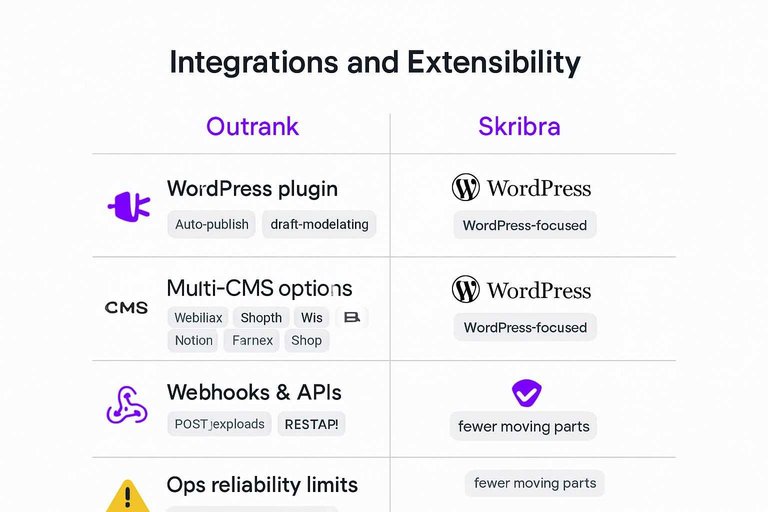
Multi-CMS options
If you publish beyond WordPress, breadth matters more than elegance.
- Outrank: Webflow, Shopify, Wix
- Outrank: Notion, Framer, Ghost
- Outrank: WordPress and WordPress.com
- Skribra: WordPress-focused
If you manage multiple properties, Outrank’s integration list reduces custom glue code.
Webhooks and APIs
Webhooks and APIs are where “autopilot” becomes your automation stack, not just your CMS.
Outrank can POST article payloads to your endpoint, which is great for custom pipelines, but the webhook must be a publicly accessible HTTPS URL. It also exposes a REST API at https://www.outrank.so/api/agent/v1 and documents possible 403 responses when an organization is not on a supported plan or lacks access to a resource.
If you already run HTTPS endpoints and you want deeper automation hooks, Outrank gives you more developer surface area.
Ops reliability limits
Integrations fail in boring, predictable ways, and those edge cases become your ongoing ops tax.
With Outrank, WordPress connection tests can fail behind firewalls, security plugins, or Cloudflare Bot Fight Mode, which may force whitelisting its API endpoints. Its webhook integration also requires a valid HTTPS endpoint, which can block quick internal prototypes or private networks.
For a smoother setup, a WordPress-only flow with fewer moving parts tends to break less.
Pricing and Packaging
Predictable cost-to-output comes down to two things: your monthly article cap and which extras are separate line items—and whether the platform bundles the “must-haves” for ongoing SEO publishing (keywords/meta, images, and publishing integrations) into the core plan.
| Package angle | Outrank published packaging | Cost predictability | Watch-outs for budgeting |
|---|---|---|---|
| Base autopilot publishing | All-in-One: $99/mo | High for 30 posts | 30/month output limit |
| Higher article volume | +$85/mo (60/mo), +$160/mo (90/mo) | High once chosen | Add-ons require base plan |
| Editorial quality layer | Human Curated: $1399/mo | High, big jump | Separate subscription add-on |
| Backlink acceleration | Backlink Premium: $199/mo | High, optional | Extra credits cost more |
| Aggressive backlink volume | Backlink Enterprise: $899/mo | High, optional | Overkill for small sites |
| Image model upgrade | Premium Images: $49/mo | High, minor | Easy to stack unnoticed |
| Lead-capture SEO assets | Free Tools Builder: $199/mo | High, optional | Not core article output |
If you need the cheapest “set-and-forget” 30 posts, outrank’s $99/mo packaging is very clean; if you want stable daily publishing without add-on stacking, you’ll feel that line-item gravity fast. In contrast, tools like Skribra tend to appeal when you’re optimizing for consistent throughput and workflow simplicity—especially if SEO basics (keywords/meta and formatting), WordPress publishing, and even optional backlink participation are part of the same system—because it reduces the chance that “small” extras quietly become the real monthly bill.
Content Governance
Autopilot publishing only works if you can control drift. Governance is where teams keep voice consistent, fix mistakes fast, and avoid “random blog” syndrome.
Rewrites and iteration
Iteration speed comes down to how fast you can change direction without breaking the pipeline. Outrank supports unlimited AI rewrites, which is useful when stakeholders keep tightening the brief.
In practice, that means you can run multiple passes for clarity, tone, and on-page SEO without rationing attempts. The tradeoff is governance still depends on your internal review rules, since volume can amplify inconsistency.
If you expect lots of mid-stream feedback, unlimited rewrites remove the bottleneck.
Human review option
Some teams can’t ship AI text without a human sign-off, for legal, medical, or finance reasons. Outrank offers a Human Curated Service add-on at USD 1399/mo to review, fact-check, and polish every article before publication.
This matters when your risk is about accuracy, not just style. It also matters when you need an audit-friendly workflow, even if it costs more than pure automation.
If compliance is the constraint, human curation becomes a governance feature, not a luxury.
Brand and formatting checks
Guardrails work when your reviewers run the same checks every time.
- Match tone to brand voice
- Verify sources and claims
- Add relevant internal links
- Normalize headings and structure
- Apply approved templates
If you want a ready-made review flow, use this essential AI content checklist as the baseline your team applies consistently.
If your tool enforces these in the workflow, reviewers stop being editors and become gatekeepers.
Quality assurance cadence
A weekly cadence catches drift before it becomes your new baseline.
- Sample a few new posts for accuracy and tone.
- Check internal links, slugs, and meta descriptions.
- Review the keyword list for intent mismatch.
- Scan publishing logs for CMS failures or drafts.
- Update templates and rules, then rerun rewrites if needed.
If your WordPress connection fails due to firewalls or security plugins, this routine surfaces it fast.
Quality assurance cadence
A weekly cadence catches drift before it becomes your new baseline.
Quality assurance cadence
A weekly cadence catches drift before it becomes your new baseline.
- Sample a few new posts for accuracy and tone.
- Check internal links, slugs, and meta descriptions.
- Review the keyword list for intent mismatch.
- Scan publishing logs for CMS failures or drafts.
- Update templates and rules, then rerun rewrites if needed.
If your WordPress connection fails due to firewalls or security plugins, this routine surfaces it fast.
Scale and Control
Article volume limits
Outrank bakes in a clear production cap, which makes forecasting easy but can pinch fast-growing calendars. The base All-in-One Plan includes 30 SEO-optimized articles per month, with add-ons that raise output to 60 (+USD 85/mo) or 90 (+USD 160/mo) for one website.
If your roadmap needs more than 90 per month per site, you’ll plan around multiple sites, multiple workspaces, or extra process.
User and team access
Publishing at scale becomes a coordination problem before it becomes an AI problem. Outrank includes unlimited users, which removes per-seat friction when you add editors, SEOs, and clients.
A real constraint shows up elsewhere: its WordPress connection can fail behind firewalls or security plugins, and may require endpoint whitelisting.
If you run many hands through one pipeline, unlimited seats is a structural advantage.
Multi-site reality
Multi-site scaling is where “autopilot” can drift into inconsistency. Ask these before you turn on the faucet across domains.
- Who owns keyword strategy per site?
- What’s your brand voice guardrail?
- Who approves before publishing?
- How do you handle shared backlinks?
- What’s your rollback plan?
Agencies usually win by standardizing governance first, then turning up volume.
Automation control points
Autopublishing needs brakes, not just an accelerator. Outrank’s WordPress plugin supports auto-publish, draft mode, and scheduled publishing, and its webhook sends article payloads to your systems.
There are two practical limits to plan for: webhooks require a publicly accessible HTTPS endpoint, and some REST API resources can return 403 if your plan lacks access.
If you’re risk-managed, you’ll treat automation as “draft-first with approvals” until you trust the pipeline end-to-end.
Where outrank Wins
Outrank can be the cleaner pick when your publishing stack is bigger than WordPress, or when multilingual output is the whole game. It still comes with real constraints, like a 30-articles-per-month base cap and integration quirks that can bite locked-down sites.
Broader integrations
Outrank covers more CMS targets out of the box, including Webflow, Shopify, Wix, Notion, Framer, and Ghost, plus a custom webhook. That matters when your “site” is really a product stack, a docs hub, or multiple properties that are not WordPress.
The catch is operational: webhook publishing requires a publicly accessible HTTPS endpoint, and WordPress connections can fail behind firewalls or Cloudflare Bot Fight Mode.
Language coverage
Outrank supports 150+ languages, which is decisive when you publish the same topic across many locales. It’s also useful when your keyword research spits out non-English clusters you actually want to pursue.
You still need a review loop for brand voice and claims, especially outside your native language.
Hands-off publishing
Solo founders like outrank when they want the system to run while they build the business.
- Publishes directly to multiple CMS options
- Automates keyword research for continuous queues
- Generates in-article AI images automatically
- Supports webhook-driven custom pipelines
- Keeps access simple with unlimited users
The tradeoff is the base plan’s 30 articles per month cap.
Key limitations
Outrank’s strengths come with edges you should plan around.
- Base plan caps output at 30/month
- Webhook endpoint must be valid HTTPS
- REST API can return 403 when plan-gated
- WP plugin can fail behind firewalls
- Cloudflare Bot Fight Mode can block connection
If these are dealbreakers, Skribra’s WordPress-first workflow is the safer default for most publishers.
Pick the autopilot you can actually live with
If your priority is consistent daily publishing with a straightforward WordPress pipeline, built-in SEO packaging (keywords, meta descriptions, formatting), automatic images, and a backlink exchange network in one place, Skribra is the more natural fit for “set a cadence and keep it moving.” Choose Outrank when you want broad CMS coverage and developer-friendly extensibility (official WordPress plugin controls plus webhooks/REST API), and you’re comfortable working within the base plan’s 30-articles-per-month cap—or paying add-ons to reach 60 or 90 articles per month. Also note Outrank’s real operational constraints: webhooks require a publicly accessible HTTPS endpoint, and WordPress connections can fail behind firewalls/security plugins/Cloudflare Bot Fight Mode without whitelisting; if those are non-starters, a simpler publishing path matters more than extra integration options.
Frequently Asked Questions
- Is “autopilot SEO content publishing” the same as programmatic SEO?
- No. Autopilot SEO content publishing automates the production and posting workflow, while programmatic SEO is a templated strategy for creating many pages from structured data (which can be published manually or via automation).
- Can Outrank or Skribra publish to WordPress automatically without me logging in every day?
- Yes, if you connect your WordPress site via the platform’s WordPress integration or API/webhook setup, articles can be drafted and pushed as posts automatically with your preferred status (draft vs published).
- How do I measure whether Outrank vs. Skribra is actually improving SEO after I turn on autopilot publishing?
- Track Google Search Console (impressions, clicks, and query/page coverage), monitor indexation and crawl errors, and use a rank tracker for your target keywords to confirm visibility changes over weeks rather than days.
- Should I autopublish every article, or keep everything in draft for review first?
- Most sites do better with a hybrid: autopublish low-risk, informational topics and keep money pages, regulated topics, or sensitive brand claims in draft for human review before going live.
- What if I also want backlinks—does either platform help beyond just publishing content?
- If backlinks are a key part of your plan, Skribra can be a better fit because it includes a backlink exchange network alongside automated content publishing, which you can evaluate as a separate lever from content volume alone.
Automate Publishing With Confidence
After comparing workflows, integrations, pricing, and governance, the real differentiator is how reliably you can ship SEO content on autopilot at scale.
Skribra generates SEO-optimized articles daily and publishes directly to WordPress with images, webhooks, and backlink support—start with the 3-Day Free Trial to see it in your stack.
Written by
Skribra
This article was crafted with AI-powered content generation. Skribra creates SEO-optimized articles that rank.
Share: