August 29, 2026
·
Updated October 2, 2026
·
13 min read
Seobot vs. Skribra: Automated SEO Content Publishing
A practical comparison of Seobot vs. Skribra for automated SEO content publishing—use a fast decision map, a side-by-side basics table, and clear breakdowns of setup control, SEO output quality, integrations, links, and scale for programmatic SEO.

If you’re trying to publish consistently for SEO, the hard part usually isn’t writing—it’s keeping quality, workflow control, and publishing automation from breaking as you scale. That’s where “autopilot” content tools can either save you time or create a new mess to manage.
This comparison walks you through what Seobot and Skribra actually automate, where you still need human checkpoints, and how each handles keyword targeting, on-page packaging, integrations, internal links, and scaling into programmatic pages—so you can pick the tool that fits your site and risk tolerance.
Fast decision map
You’re choosing between two “publish-for-me” SEO systems, not two writing assistants. The fastest path is matching your workflow: hands-off autopilot versus a WordPress-first daily publishing engine with a built-in backlink exchange.
Pick Skribra when you want steady, formatted daily posts flowing into WordPress, plus an ecosystem for backlinks. Pick SEObot when you want an agent-led system that researches, plans, and publishes with stronger in-app moderation and multi-CMS options.
What each is
Skribra is an AI content platform that generates SEO-optimized articles daily and publishes to WordPress with images, webhooks, and a backlink exchange network.
SEObot is a fully autonomous “SEO Robot” that researches keywords, plans content, generates long-form posts, and publishes to your CMS with internal linking and approvals.
Best-fit readers
Choose based on who owns publishing and how many properties you run.
- Solo founders: SEObot for true autopilot
- Agencies: SEObot for volume workflows
- Niche site builders: Skribra for daily cadence
- Multi-site operators: SEObot for multi-CMS reach
If you’re constantly context-switching, autonomy wins; if you’re consistency-driven, cadence wins.
If you need X
Match your must-have to the tool that’s built around it.
| Need | Better tool | Why | Watch-out |
|---|---|---|---|
| Autopilot SEO | SEObot | Agents plan + publish | Plans shown after onboarding |
| WordPress publishing | Skribra | Native WordPress flow | WP-centric by design |
| Scale across CMS | SEObot | Webflow, Shopify, Ghost | Refund limited to $49 plan |
| Editing control | SEObot | Approve/decline + editor | API access needs credits |
| Backlinks | Skribra | Backlink exchange network | Network fit matters |
| Programmatic pages | SEObot | Templates + data + publish | Requires template discipline |
When two tools both “write,” the real differentiator is who owns the workflow edges.
Non-negotiables check
Before you spend onboarding time, run two fast checks.
First, confirm niche suitability: SEObot explicitly warns adult/NSFW topics may be refused or generalized by safety filters.
Second, confirm required integrations: Skribra is strongest when WordPress is your publishing hub, while SEObot supports WordPress, Webflow, Shopify, Ghost, HubSpot, Notion, and webhooks (see https://seobotai.com/ rel=“nofollow”).
Do these checks now, or you’ll debug “tool fit” after you’ve already shipped the wrong system.
Side-by-side basics
You’re comparing two “publish for me” systems, so the only useful view is end-to-end. Use this grid to see where each tool is strongest, and where you’ll still need human judgment.
| Capability | SEObot | Skribra |
|---|---|---|
| Research | Site, audience, keyword research | Keyword-focused SEO optimization |
| Planning | Creates content plan | Daily publishing cadence |
| Writing | Up to 4000 words | SEO-optimized articles |
| Publishing | WordPress, Webflow, Shopify, Ghost, HubSpot, Notion | WordPress integration |
| Editing | Approve/decline + in-app editing | Not specified |
| Images | Generates + inserts Google Images | Automatic image generation |
| Linking | Internal linking automation | Backlink exchange network |
| Extensibility | Webhooks + REST API + Next.js examples | Custom webhooks integration |
Setup and control
Onboarding flow
You care about onboarding because it determines how fast you can publish, and how many decisions you can still change. The tradeoff is simple: faster setup usually means fewer early checkpoints.
SEObot leans into speed with automated onboarding where you enter your URL and start. One practical caveat: its full subscription plan list isn’t publicly visible until after website onboarding.
If your team needs budget clarity before any setup, that visibility gap becomes a real friction point. See SEObot’s note on pricing visibility after onboarding.
Editorial checkpoints
Control lives in the “last mile”: approvals, edits, and the ability to stop a bad post. Both tools can automate drafts, but teams differ on how much they want to intervene.
- Approvals: SEObot supports approve-or-decline moderation.
- Editing: SEObot allows in-app edits before publishing.
- Stop button: SEObot can decline a piece outright.
- Hands-on feel: More controls suit tighter brand governance.
- Hands-off feel: Fewer gates suit high-volume publishing.
If someone must own final wording, moderation controls are the difference between publishing and merely generating.
Automation boundaries
Automation is safest when the content is repeatable and the downside is low. The risk climbs fast with regulated claims, brand promises, or anything that can harm a reader.
SEObot can automate research, planning, internal linking, and publishing to your CMS. Even with its fact-checking and citations claims, you still want human review for brand voice, legal language, and YMYL topics like medical, finance, or safety.
Automate the pipeline, but keep a human on the final liability.
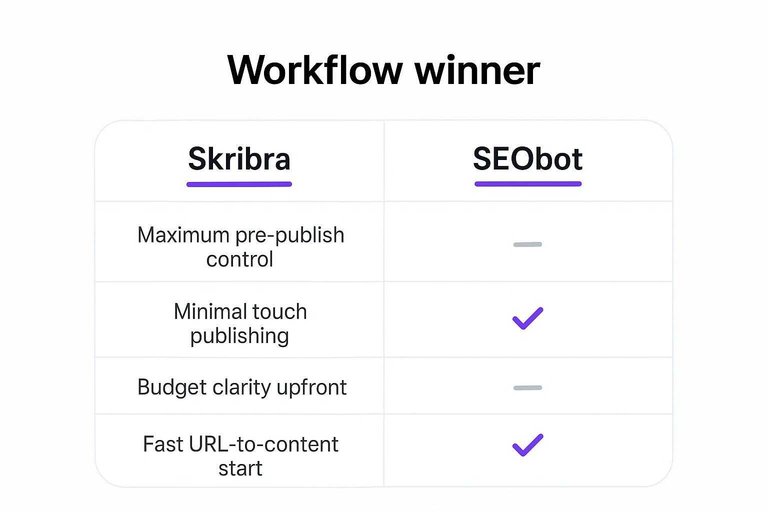
Workflow winner
Different teams optimize for different failure modes: accidental publishing versus slow publishing. This table maps each workflow to the kind of control posture it fits.
| Team preference | Better fit | Why | Practical example |
|---|---|---|---|
| Maximum pre-publish control | Skribra | More deliberate gates | Compliance edits before publish |
| Minimal touch publishing | SEObot | Autopilot posture | Founder ships weekly posts |
| Budget clarity upfront | Skribra | Plans visible earlier | Team compares tiers first |
| Fast URL-to-content start | SEObot | Automated onboarding | New site starts quickly |
Pick based on what you fear more: a flawed post going live, or a good post never shipping.
SEObot free trial: how to check availability and evaluate it
If you’re searching for “seobot free trial” (or “seobot free trail”), treat any offer as time-sensitive and verify it directly in SEObot’s own product flow and docs—especially because plan visibility can change after onboarding.
How to verify whether a free trial is currently available
- Start from the official onboarding: go to SEObot’s site and begin the URL-based setup. Watch for trial messaging at the moments that matter: account creation, connecting your site/CMS, and the point where you’re asked to select or confirm a plan.
- Check the docs/support pages for the current policy: look for explicit language about trials, cancellations, and when billing begins. If you only see references to pricing visibility after onboarding, assume you’ll need to complete initial setup to see the latest options.
- Confirm inside your account: the most reliable signal is what your dashboard shows right before you would be billed (e.g., a trial banner, a “trial ends” date, or an upgrade screen).
Trial terms to read before you rely on it
- When billing starts: immediately, after a time window, or after you publish.
- What counts as usage: whether “generating” content, “publishing” content, or connecting your CMS/Search Console consumes the trial.
- Limits and exclusions: caps on articles, sites/projects, or features (like publishing, moderation, or integrations).
- Cancellation path: where you cancel (in-app vs. support) and whether cancellation stops publishing automation.
- Data/content ownership: what happens to drafts, published posts, and connected accounts if you don’t continue.
What to test during a trial (so you don’t learn it after paying)
- Onboarding friction: how quickly you can go from URL → first draft, and what can be changed after setup (site settings, categories, voice rules).
- Editorial checkpoints: run at least one article through approve/decline moderation and in-app edits to see if the “last mile” control matches your governance needs.
- Automation boundaries: deliberately test a sensitive topic you care about (brand promises, regulated language, YMYL-adjacent content) and verify your internal review process can catch issues before publish.
- CMS publishing and rollback: publish to a non-production category or staging environment first; confirm you can stop/decline content and that the system won’t keep pushing unwanted posts.
If trial availability isn’t clearly stated, treat it as “unknown” until you see the exact terms in your account, and run your evaluation in a safe environment where accidental publishing is low-risk.
SEO output quality
Keyword targeting
Good SEO content starts before you draft a sentence. It lives or dies on how you pick queries, map intent, and plan clusters.
Skribra leans into repeatable keyword inclusion and consistent SEO-oriented templates, with keywords and metadata baked into the workflow. That makes it easier to keep daily publishing aligned with a clear, steady pattern—especially when you already know the themes you want to own.
SEObot puts more emphasis on site and audience research during onboarding, then builds a content plan from that. It’s also built to keep internal links coherent as the library grows, which changes how keyword clusters behave over time.
If your site already has a clear positioning, consistency often beats “more ideas.”
On-page packaging
You can verify output quality by checking what lands in your CMS, every single time. Focus on what’s visible: metadata, structure, and formatting discipline.
- Meta titles and descriptions included consistently
- Heading hierarchy that matches intent sections
- Tables and lists used for scannability
- Images and embeds placed intentionally
- Formatting consistent across posts
This is an area where Skribra’s SEO-optimized formatting (including meta descriptions and predictable structure) can make QA feel more mechanical—especially when you’re publishing frequently or pushing directly into WordPress. If you need a baseline checklist, this SEO guide for on-page packaging can help you spot issues faster. When packaging is predictable, editing becomes a spot-check instead of a rewrite.
Long-form depth
Depth is less about word count and more about coverage discipline. Still, maximum length affects what you can realistically publish in one pass.
SEObot supports articles up to 4000 words, plus tables, lists, and YouTube embeds. That’s useful for topics that need examples, edge cases, and step-by-step walkthroughs in one URL.
Skribra is optimized for frequent publishing, so many teams use it to keep a steady cadence while still shipping SEO basics like keywords, meta descriptions, and consistent formatting. The trade-off is you may prefer splitting deep topics into a series rather than one long page.
Choose depth when ranking depends on completeness, not just presence.
Quality winner
Quality control is mostly workflow: what gets checked, what’s editable, and what stays consistent at scale.
| Criteria | SEObot | Skribra |
|---|---|---|
| Onboarding research | Site and audience research | Template-led setup |
| Pre-publish control | Approve/decline + edit | Publish workflow focus |
| Long-form ceiling | Up to 4000 words | Cadence-first output |
| Reliability signals | Citations system described | Formatting + metadata emphasis |
If you want fewer surprises in what appears on-page (titles, metas, structure) day after day, Skribra’s consistency-forward approach is often the safer bet. If you want fewer surprises in topic selection itself, prioritize the tool with stronger gates before publishing.
Publishing and integrations
CMS coverage
You’re choosing between a WordPress-first workflow and a broader CMS footprint. The destination list matters because it sets your ceiling for automation.
| Destination | Skribra | seobot | Notes |
|---|---|---|---|
| WordPress | Yes | Yes | Direct publishing |
| Webflow | No | Yes | Multi-site stacks |
| Shopify | No | Yes | Storefront content |
| Ghost | No | Yes | Publisher setup |
| HubSpot | No | Yes | Marketing site CMS |
| Notion | No | Yes | Database sync |
If you’re not on WordPress, CMS support becomes the entire decision. SEObot lists supported destinations in its CMS integrations documentation.
WordPress publishing
If your whole operation lives in WordPress, the publishing experience is mostly about cadence and control. The key question is whether you want “publish automatically” or “queue with approvals.”
Skribra’s strength is straightforward WordPress integration, which keeps the loop tight from generation to posting. seobot also supports WordPress, and it adds moderation controls where you can approve or decline, plus in-app editing before publishing.
Your bottleneck won’t be writing. It will be deciding how much review your workflow can tolerate.
Extensibility
Integrations decide how well the tool fits your stack after the first month. You’re looking for simple triggers, clean payloads, and predictable failure modes.
- Use webhooks for publish-time automations and routing.
- Use REST APIs for custom CMS or app-driven publishing.
- Use event hooks for approvals and content updates.
- Use headers for internal auth and routing.
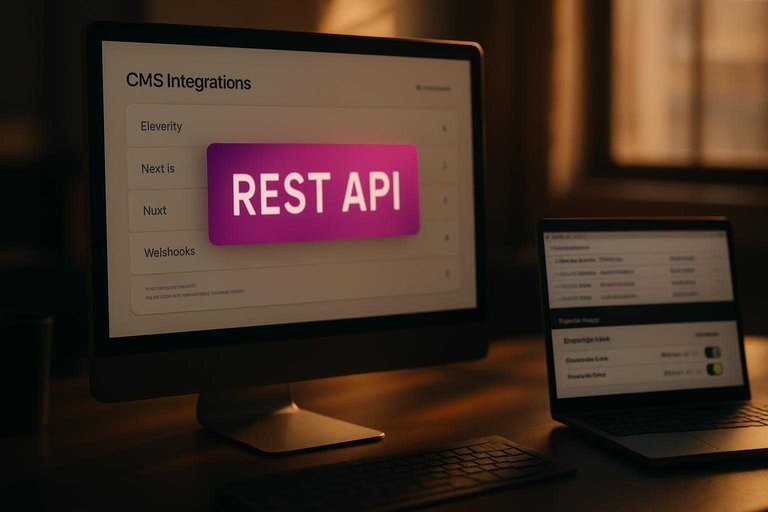
seobot supports webhooks for article created and updated events via POST with optional custom headers. It also offers a REST API and a Next.js integration via an npm package and GitHub examples, but REST access is only available once you have at least one article credit.
If you need custom workflows, extensibility beats “one more toggle” every time.
Integration winner
If you’re running a multi-platform stack, seobot has the clearer advantage because it publishes beyond WordPress and supports webhooks plus a REST API. It also has real constraints, like REST access requiring at least one article credit and adult or NSFW niches not being fully supported.
If you’re WordPress-first and you value a tighter, simpler loop, Skribra’s direct WordPress integration is the cleaner fit. That simplicity makes it easier to keep a steady cadence without building extra glue.
Pick the tool that matches your “where it must ship” reality, not your future architecture diagram.
Links and authority building
Internal linking
SEObot automates internal linking across new articles and existing site pages, so structure keeps improving without extra passes. That’s useful when you publish frequently and don’t want to babysit hubs, related posts, and contextual anchors.
A publishing-first workflow tends to leave internal links as a “later” task.
You usually handle it by:
- defining pillar pages and target URLs
- adding link blocks during edits
- running periodic internal-link audits
- updating older posts to match new topics
Automation wins on consistency, while manual control wins on intent. The real question is whether you want guardrails or a steering wheel.
Backlink options
Both products acknowledge links matter, but they approach them from opposite ends: discovery versus exchange.
| Capability | Exchange network | Opportunity discovery | Your effort |
|---|---|---|---|
| Primary input | Member sites | Web link signals | You decide |
| Primary output | Reciprocal backlinks | Target prospects | Outreach tasks |
| Built-in control | Network rules | AI suggestions | Manual approval |
| Best-fit use | Fast baseline links | Custom campaigns | Quality vetting |
If you want links to “happen,” networks feel turnkey; discovery still needs human follow-through.
Practical risks
Links move authority, but they also create footprints and liabilities. You need checks that match your risk tolerance.
- Relevance drift from broad network matching
- Quality control gaps on linking domains
- Footprint risk from patterned exchanges
- Manual vetting required for outreach targets
- Anchor text over-optimization from templates
Treat link systems like infrastructure, not a growth hack. One bad pattern can shadow every page you publish.
Links winner
For turnkey authority-building, a backlink exchange network is the more “plug-in” option, and Skribra is built around that convenience. For discovery-first workflows, SEObot’s AI-driven link opportunity discovery fits teams that prefer handpicked placements and custom outreach.
Pick based on your constraints, not your ideology. If you can’t run outreach, discovery won’t convert into links.
Scale and programmatic SEO
Volume publishing
Skribra is built around a daily-article cadence, which suits brands that win by showing up every day. SEObot’s model is closer to weekly production, with research, planning, and batch output handled for you.
If you want momentum through consistency, Skribra’s daily positioning is the cleaner fit. If you want “set it and forget it” with fewer decisions, SEObot’s weekly cycle can feel calmer. If you’re weighing what “automation” actually looks like in practice, see these real-world automated SEO content examples.
Programmatic pages
Programmatic SEO is about turning one strong pattern into hundreds of targeted pages. SEObot explicitly supports programmatic projects via templates, data collection, and CMS publishing at scale.
- Build template-driven page types from a repeatable structure
- Collect structured data for each page instance
- Publish batches directly to your CMS
- Pair pages with automated internal linking
- Use it for directories and comparison pages
If your roadmap is “one template, many pages,” SEObot is the more purpose-built choice.
Operational overhead
At high volume, the hard part is not writing. It’s keeping topics clean, voice consistent, and pages non-duplicative as your site grows.
You’ll still need topic QA, brand voice guardrails, and deduplication rules. You’ll also need a site architecture that prevents orphan pages and keyword cannibalization.
That hidden work is where daily publishing either compounds, or quietly collapses.
Scale winner
Pick based on whether you’re scaling a template system or a publishing habit.
| Scenario | Winner | Why | Best for |
|---|---|---|---|
| Template-driven growth | SEObot | Programmatic templates + scale publishing | Directories, marketplaces |
| Steady low-effort cadence | Skribra | Daily article positioning | Content-led brands |
| “Autopilot” ops | SEObot | Weekly production + moderation | Busy founders |
| Consistent daily presence | Skribra | Routine output + WP publishing | Small marketing teams |
Recommendation: choose Skribra if you want daily, consistent publishing without turning your site into a template project. Choose SEObot if programmatic SEO is your core growth lever, and you can live with its real constraints like limited refunds on only the $49 plan and incomplete public plan visibility until after onboarding (see https://seobot.ai).
Choose your lane, then commit to a workflow
If you want the cleanest path to “publish daily without babysitting,” with WordPress publishing, automatic image generation, webhook flexibility, and a built-in backlink exchange network, Skribra is the more straightforward fit for steady, repeatable output. Pick Seobot (https://seobot.ai/ “nofollow”) when you’re a busy founder who wants a more autonomous system that researches, plans, writes long-form articles (up to 4000 words), and can push into programmatic SEO templates—with moderation controls and broad CMS options like Webflow, Shopify, Ghost, and HubSpot. Keep the limitations in view: Seobot’s full plan list isn’t visible until after onboarding, refunds are limited to the $49 plan after the first article, and adult/NSFW niches aren’t fully supported; whichever tool you choose, define your non-negotiables (review checkpoints, automation boundaries, and publishing cadence) before you scale volume.
Frequently Asked Questions
- Do Seobot and Skribra support topical authority and content clusters, or are they mainly for single keywords?
- Most automated SEO publishers work best when you plan topic clusters (pillar + supporting posts) and enforce consistent internal linking and category structure. Use a shared keyword map and a fixed template so each article targets one primary intent while reinforcing the cluster.
- How do I QA automated SEO articles before they publish so I don’t risk brand or factual errors?
- Add a pre-publish checklist: verify claims and sources, scan for hallucinations, confirm on-page SEO (title, H1/H2s, meta description), and review internal/external links. If the tool supports approvals, route drafts to a staging site or require manual approval before going live.
- What should I track to judge whether automated SEO content publishing is working?
- Track indexation and coverage in Google Search Console, then monitor impressions, queries, and average position per page, plus engagement signals in analytics. Also review crawlability (sitemaps, canonicals, internal links) to ensure new pages are discoverable.
- Can I use Seobot or Skribra if my site isn’t on WordPress?
- Yes—most workflows can still work via exports (Markdown/HTML/CSV) or API/webhooks into your CMS, then publish through your existing pipeline. Confirm the tool can output clean HTML, metadata, and images in a format your CMS accepts.
- Is a backlink exchange network safe, and how should I use it without triggering penalties?
- It’s safest when links are earned in context, placed on relevant pages, and kept selective rather than mass-swapped. If you want a built-in option for this, Skribra’s backlink exchange network is designed for controlled participation—still review relevance and anchor text before accepting links.
Automate Publishing and Authority
After comparing setup, output quality, integrations, and scale, the next step is choosing a workflow you can run daily without constant oversight.
Skribra generates SEO-optimized articles, publishes to WordPress, and supports authority growth with a backlink exchange network—start with the 3-Day Free Trial.
Written by
Skribra
This article was crafted with AI-powered content generation. Skribra creates SEO-optimized articles that rank.
Share: