October 2, 2026
·
8 min read
What Is SEO Content Marketing and How Does It Work?
SEO content marketing explained: how Google discovers, crawls, indexes and ranks content, plus a repeatable create-to-refresh loop with Search Console.


You publish useful content, but it still doesn’t show up when the right people go looking for it. That usually isn’t a “write more posts” problem—it’s a breakdown somewhere between being discovered, being understood, and being chosen in search results.
This explainer gives you a clear model of what “SEO content marketing” means, how the search pipeline works (crawl, index, serve), what truly moves the needle, and a step-by-step workflow—including AI guardrails and a feedback loop to keep pages from decaying.
The overlap
SEO content marketing is the overlap of two jobs that are easy to separate on a whiteboard and hard to separate in real life: making content discoverable in search, and creating plus distributing content to drive action. In that overlap, “publish” stops being a single button-click and becomes a system—what you make, how you package it, where it lives, and how it gets found.
SEO, in plain terms
SEO (search engine optimization) is the work of helping search engines understand your content and helping users find your site—and decide to visit—through search. Google frames it exactly that way: clarity for machines, and a better decision for humans. The practical implication is blunt: content can exist on your site and still never show up, because Google Search doesn’t guarantee every page makes it through its stages (crawling, indexing, then serving results).
Content marketing’s job
Content marketing is the strategic approach of creating and distributing valuable, relevant, consistent content to attract and retain a clearly defined audience—and ultimately drive profitable customer action. That “distributing” clause is the tell: content marketing assumes you’ll actively get the work in front of people, not just store it on your blog.
SEO content marketing is what you’re doing when you design creation and distribution so search can surface the piece at the moment someone goes looking for it.
Google’s search pipeline
Google Search works like a pipeline: discover URLs, crawl them, index what’s eligible, then serve results for a query.
URL discovery comes first because there isn’t a central registry of all web pages. Google is constantly looking for new and updated URLs, and it finds them by extracting links from pages it already knows about and by reading submitted XML sitemaps.
Crawling is search engines fetching pages (and their resources) to discover what exists on the web. When Googlebot crawls, it doesn’t just read raw HTML; it renders the page and runs the JavaScript it finds using a recent version of Chrome. If your key content only appears after scripts run—or important resources can’t be fetched—what Google sees during the crawl can differ from what you see in your browser.
Indexing is search engines analyzing a page and storing information about it in an index so it can be returned for queries. Google’s indexing requirements start with basics: Googlebot can’t be blocked, the URL must return an HTTP 200 status code, and the page needs indexable content—and even then, indexing isn’t guaranteed. A common failure mode is mixing up crawl control with index control: blocking Googlebot in robots.txt can stop crawling, but the URL can still appear in results; if you want to keep a page out of the index, use a noindex directive while still allowing it to be crawled.
Serving (search results) is the stage where the search engine selects and returns results for a query from what’s indexed. If a page is discovered and indexed but still doesn’t show up, you’re no longer debugging “can Google find it?”—you’re debugging relevance and authority for that specific query, which is covered in this complete SEO guide.
What moves the needle
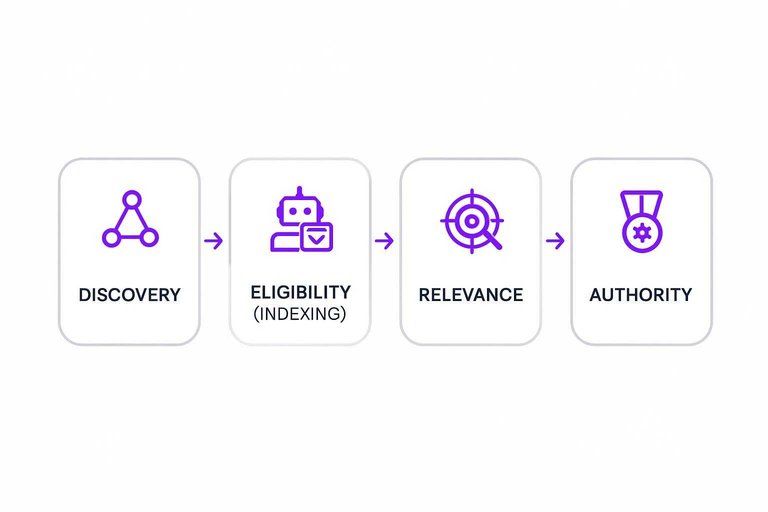
Every SEO content marketing task maps to a stage in search. Match the fix to the stage and you stop “doing SEO” as a checklist.
At the relevance stage, you’re matching search intent (the underlying reason someone searches a query, inferred from what ranks) not just sprinkling keywords. At the eligibility stage, basic crawl/index controls matter: robots.txt (a file that can block crawlers from fetching URLs) and noindex (a directive telling search engines not to index a page, which crawlers must be able to access to see).
| Search stage | Actions that move it | Common blockers | What “good” looks like |
|---|---|---|---|
| Discovery | Internal links, XML sitemap, promotion | Orphan pages, weak linking | Google can reach the URL via internal links and/or the XML sitemap |
| Eligibility (indexing) | Clean 200 status, allow crawl, correct noindex use | robots.txt blocks, accidental noindex | Googlebot can fetch the page and it has indexable content |
| Relevance | Intent-led brief, clear page structure, people-first depth | “Right topic, wrong angle” | Fits the SERP pattern |
| Authority | Earn references/mentions, build reputation (E-E-A-T) | No references/mentions, thin reputation signals | Trusted enough to win |
The stage you’re stuck at tells you what to do next: discovery work is links/sitemaps, eligibility work is crawl/index controls, relevance work is intent and structure, and authority work is earning references and building reputation.
A repeatable workflow
You learn SEO by running a simple loop end-to-end, then improving one checkpoint at a time. It’s not “hard” in the sense of hidden tricks; it’s hard because it demands consistency across topic, page, and follow-up.
- Pick a topic with a job to do. Good looks like: one clear search intent and a clear next action for your business.
- Write a one-page brief. Good looks like: target query, what must be true by the end of the article, and the sections needed to satisfy the intent.
- Draft for people first, then tighten for search. Good looks like: the piece is helpful on its own (Google calls this “people-first content”), not just “keyword coverage.”
- Structure the page for scanning and indexing. Good looks like: one primary H1, descriptive H2s, and answers that appear where a skimmer expects them.
- Publish cleanly. Good looks like: the URL resolves (no broken states), and the page is reachable from your site’s navigation or internal links.
- Distribute on purpose. Good looks like: you create discovery paths (internal links, email, social, communities) instead of waiting for Google to “find it.”
- Monitor in Google Search Console (Google’s performance and indexing dashboard). Good looks like: you can see impressions/clicks and spot pages that are discovered but not winning.
- Refresh, don’t abandon. Good looks like: you maintain winners and underperformers—updating facts, titles, and internal links as needed.
If you want the workflow operationalized, this SEO content streamlining checklist is a useful reference, and Skribra is an example of a system that automates the plan→write→publish→index→maintain loop on your site (including a rolling 30-day content calendar and publishing to WordPress, Shopify, Webflow, Notion, or via webhook).
AI-era boundaries
SEO isn’t dead in the AI era; the volume hacks are. Google explicitly allows AI-assisted creation, and it explicitly targets content made at scale primarily to manipulate rankings.
- Use AI as a production tool, not a ranking trick. Google says appropriate use of AI/automation isn’t against its guidelines—what violates policy is using it primarily to manipulate search rankings.
- Anchor everything in people-first content (content created primarily to help people, not primarily to gain rankings). Google’s guidance is blunt that SEO is fine when it’s applied to people-first content rather than “search engine-first” content.
- Don’t cross into scaled content abuse (generating many pages primarily to manipulate rankings, often unoriginal and low-value, no matter who/what wrote them). Google calls out using generative AI to mass-produce pages “without adding value for users.”
- Avoid page-per-variation publishing. Google warns that creating separate pages for every possible query wording primarily to manipulate rankings (or AI responses) violates the scaled content abuse policy.
- Stop optimizing for “the right length.” Google states there’s no ideal page length—usefulness is the constraint, not word count.

Close the loop
Publishing is the midpoint. SEO content marketing only holds its gains when you run a maintenance loop—Ahrefs describes its SEO content marketing strategy as creating and maintaining high-quality, product-led, search-focused content, with “maintain … content” as part of the method, not an optional extra.
- Read the signals (Search Console-style). Watch for slipping clicks/impressions, queries you’re showing for but not winning, and pages that stop getting discovered.
- Triage the cause, not the symptom. Decide whether it’s a relevance problem (the page no longer matches intent), a presentation problem (title/snippet underperforms), or a discoverability problem (weak internal links).
- Fix the page in place. Refresh facts, tighten the “what this page is for,” and add/repair internal links so the page stays connected to your site’s newer work.
- Consolidate when you have overlap. Consolidation means merging competing pages into one stronger page (and redirecting the extras) so you stop splitting signals across near-duplicates.
- Re-check, then standardize the pattern. When a fix works, turn it into a repeatable checklist for the next refresh cycle.
Diagnose the stage, then fix it
If your “useful” content isn’t showing up, the answer isn’t to publish more—it’s to stop guessing and identify where the page is failing in the search pipeline: discovery, indexing eligibility, relevance, or authority. SEO content marketing works when creation and distribution are designed for that pipeline, so Google can find the URL, understand it, and choose it for the query because it matches intent and carries enough trust. Start with one page: use Search Console-style signals to pinpoint the stuck stage, fix the cause in place (structure, intent fit, internal links, title/snippet), and keep running the refresh loop so your winners don’t quietly decay. Do that with people-first content—and avoid scaled, page-per-variation output—and SEO stops being a checklist and becomes a repeatable operating system.
Frequently Asked Questions
- Is SEO dead now with AI, or does SEO content marketing still work in 2026?
- SEO content marketing still works with AI—Google’s line is about intent and quality, not whether a human or AI wrote it. Use AI to speed up production, and avoid generating pages primarily to manipulate rankings at scale.
- Do I need technical SEO to do SEO content marketing, or can content alone rank?
- You need enough technical SEO to make pages eligible for indexing (crawlable, indexable, and returning a clean HTTP 200), then content and authority decide whether you rank. Use Google Search Essentials as the baseline checklist for what needs to be indexable and accessible.
- Is structured data (schema.org / JSON-LD) required for SEO content marketing?
- Structured data isn’t required to rank, but it is required if you want search engines to understand and qualify your page for specific rich-result features that depend on schema. If you add it, use schema.org vocabulary in JSON-LD so it’s explicit and machine-readable.
- Can I automate SEO content marketing without creating thin, spammy content?
- Yes—automate the workflow and QA, not the “publish 1,000 pages” tactic: start from real keyword demand, write to a clear search intent, and keep a maintenance loop after publishing. Skribra is built for this system approach by pulling 2,000+ keywords via DataForSEO and handling writing, publishing, and indexing to WordPress, Shopify, Webflow, Notion, or a webhook.
- How do I get new SEO content discovered and indexed faster after publishing?
- Give the URL discovery paths (internal links plus an XML sitemap), then submit it to the search engine and confirm it’s crawlable and returns a 200. If you support IndexNow, you can trigger indexing pings—Skribra’s workflow includes IndexNow and claims indexing within 24h.
Run the SEO maintenance loop
Diagnosing the pipeline stage is the easy part; keeping pages moving through indexing, relevance, and authority week after week is where most teams stall.
Skribra is an AI-driven SEO content system that plans, writes, publishes, and maintains articles on your site using Search Console signals to refresh titles, facts, and internal links—plus a 3-Day Free Trial.
Written by
Skribra
This article was crafted with AI-powered content generation. Skribra creates SEO-optimized articles that rank.
Share: