September 12, 2026
·
8 min read
How to Check Keywords on Google: 9-Point SEO Checklist
A 9-point checklist to keyword check Google using Search Console, Keyword Planner, Trends, and a controlled SERP + URL Inspection check.

You’re trying to decide which keyword to target next—or whether a page you already published is actually showing up for the searches you care about.
If you just type the term into Google and trust what you see, you can waste a week rewriting the wrong page, chasing a “drop” that’s really personalization or location, or treating ad metrics like they’re SEO difficulty. This checklist gives you a repeatable, tool-by-tool way to confirm what you rank for, why a keyword might look missing, what the demand looks like, how interest is trending, and what the live results page is really doing.
Define the check
“Keyword check Google” can mean four different measurements, and mixing them is how teams end up arguing with screenshots.
A rank check answers: where (and how often) your page shows for a query right now. A demand check answers: is this query searched enough to justify the work. A trend check answers: is interest rising, falling, or seasonal—Google Trends is normalized on a 0–100 scale from a sample, so it’s for relative direction, not absolute volume. An indexability check answers: can your page even appear—Search Console’s URL Inspection tool treats “URL is on Google” as eligibility to appear, not a promise you’ll rank or show for a given search.
Lock your context
Before you touch any tools, write these down and keep them fixed:
- Target country/location (Google says results can differ by location).
- Language (the language you want results in, not just your UI language).
- Device (mobile vs desktop can change what Google shows).
- Date range (a snapshot week vs a quarter are different questions).
Pick the outcome
Choose one goal per keyword, then run the matching checks:
- Measure current performance (ranking visibility for your site).
- Validate demand (whether the topic is worth targeting).
- Confirm seasonality (whether timing will help or hurt).
- Verify indexability/eligibility (whether the page can appear at all).
Hold the context constant, pick one outcome, and every later “check” becomes comparable and repeatable instead of a one-off Google search.
Lock your context
Pick the outcome
Pull GSC rankings
Google Search Console is Google’s free tool for monitoring a site’s presence in Google Search results; to check keyword rankings on Google for your own site, the fastest path to action is the Performance report.
-
Open Search Console → Performance → Search results. Set the same context you locked earlier (date range, country, device, search type).
-
Start on the Pages view. Pick a page you care about (or filter to a folder), so you’re evaluating keywords in the context of the URL Google actually shows.
-
Switch to Queries. You now have real query–page pairs: the terms that triggered impressions for that specific page.
-
Triage with the metrics:
- Clicks = traffic you already earned.
- Impressions = how often Google showed you.
- CTR (click-through rate) = clicks divided by impressions; it can drop simply because you started showing more often in lower positions.
- Average position is an average across impressions, not “your rank today,” so treat it as a trend line, not a screenshot.
- Don’t panic when a manual Google search doesn’t match. Google says results can differ between people because of things like location and time, and turning off personal results doesn’t remove those other differences—so a single SERP view is a spot-check, not the source of truth.
Fix missing keywords
If a query doesn’t show up in your Search Console tables, don’t treat it as “we don’t rank.” The Performance report has two built-in blind spots: anonymized queries (withheld for privacy) and table truncation (the UI shows only the most important rows).
-
Confirm you’re chasing a reporting gap, not a real zero. In the Performance report, compare the chart totals (clicks/impressions) to what your visible query rows add up to. If the table can’t “explain” the totals, you’re looking at missing rows—privacy, truncation, or both.
-
Decide whether you need a complete query baseline or just a quick check. If this keyword check is going into a report, a content plan, or a “before/after” measurement, don’t rely on the UI table as your dataset—Google explicitly recommends exporting for the most complete list of queries.
-
Use bulk data export when you want completeness and repeatability. Search Console’s bulk data export sends performance data to BigQuery on an ongoing basis and isn’t affected by the daily UI row limit, but it still excludes anonymized queries.
-
Use the Search Analytics API when you need flexible pulls. The Search Analytics API lets you query by dimensions (query/page/country/device) and extend analysis beyond the UI’s Last 16 months view, but Google notes it can still return “top rows,” not every possible row.
-
Save the export as your baseline. Keep a dated extract (or a daily export) so future “keyword check Google” runs are comparisons, not fresh guesses.

Read Keyword Planner
Google Ads Keyword Planner lives inside Google Ads, so it’s not a “free Google keyword search” in the no-strings sense: Google says you must complete account setup by entering billing information to access basic features like keyword suggestions.
Use it to size demand and commercial intent, but treat every metric as paid-auction data—not organic difficulty.
| Keyword Planner signal | What Google says it measures | How to use it for SEO priority |
|---|---|---|
| Keyword ideas | Ads-oriented variants | Build a target set |
| Avg. monthly searches | Demand, not clicks | Size opportunity |
| Competition | Advertiser presence | Intent proxy, not SEO |
| Top-of-page bid (low/high) | ~20th/~80th percentile CPC | Commercial value signal |
| Competition index (API) | 0–100 bucketed score (LOW = 0–33, MEDIUM = 34–66, HIGH = 67–100) | Coarse screening only |
Two practical gotchas: Keyword Planner limits each new keyword to 80 maximum characters, and “Competition” is literally about how many advertisers showed on that keyword relative to all keywords—so a “High” label can mean “valuable to advertisers,” not “hard to rank.” If you want business value signals, sort by meaningful volume plus top-of-page bid ranges, then hand those candidates off to your organic checks.
Validate with Trends
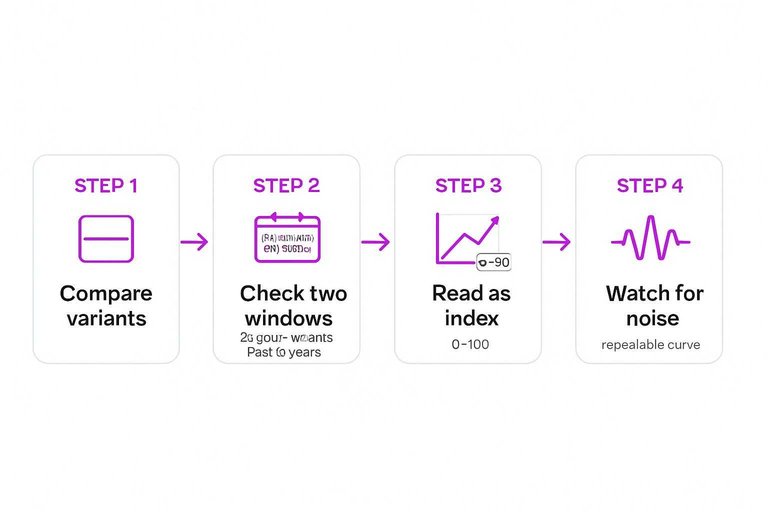
-
Compare variants in one view. Add 2–5 close phrases (singular/plural, word order) and keep the same country and date range.
-
Check two windows: Past 12 months for upcoming timing, then Past 5 years to confirm it’s true seasonality, not one spike.
-
Read the chart as an index. Google Trends uses sampled, normalized data on a 0–100 scale, so you’re comparing shapes and relative lift—not estimating “searches per month.”
-
Don’t overread 0. Trends filters very low-volume searches, so “0” can mean “too small to report,” not “no one searches.”
-
Watch for noise. Trends includes statistical noise that shows up most on low/no-interest queries—pick the variant with a repeatable curve, then publish ahead of its peak.
Controlled SERP check
Use this when your tool data says one thing, but a live Google SERP (search engine results page) looks different.
-
De-personalize the search before you judge the SERP. Turn off personal results in Search settings when you can; Google says results can still differ for other reasons like location and timing.
-
Use Incognito for cleanup, not “truth.” Chrome says Incognito doesn’t change how websites (including Google) collect data during the session, so treat it as a way to avoid your normal signed-in history—not as a neutral lab.
-
Verify the exact query you think you’re checking. Use operators to cut through noise:
- “keyword check google” (quotes = exact phrase)
- site:yourdomain.com “keyword” (only your site)
- keyword -brand (exclude a term)
- after:2024-01-01 / before:2024-01-01 (freshness)
- filetype:pdf (format)
Google’s operator rule: don’t put a space between the operator and its term.
-
When “we don’t show” might be indexing, open URL Inspection. It reports Google’s indexed version of your URL; “URL is on Google” means eligible to appear, not a guarantee it will rank for that query.
-
Classify the mismatch. If indexed but not visible, it’s a ranking or intent match problem; if not eligible, it’s an indexability problem—different fixes, different owners. If you’re standardizing how teams run this check, keep a list of resources to simplify SEO workflows so everyone follows the same process.
9-point SEO checklist
Run this to reconcile tool data with the live SERP (Google results can differ by location and timing). If you’re doing this weekly, Skribra can automate publishing and refresh existing posts based on Search Console performance signals—see the complete SEO guide for the full workflow.
- Lock country, language, device, and date.
- Turn off personal results (if available).
- Use Incognito for cleanup only; Google can still collect data.
- Search the exact phrase in quotes.
- Use
site:yourdomain.com "keyword"to verify coverage. - Add
-brandto remove brand bias. - Use
before:/after:to test freshness effects. - If you “should” show, use URL Inspection and confirm “URL is on Google.”
- Compare SERP intent to your page’s format/angle.
Decision: not eligible → fix indexing; eligible but wrong intent → publish new; eligible but aligned → update.
Make your next keyword decision
Stop “checking keywords on Google” by eyeballing a single search result and calling it a rank change. Lock your context, use Search Console query–page pairs as your source of truth (export when you need a baseline), then size demand with Keyword Planner and time it with Trends without confusing ad-auction signals for SEO difficulty. When the numbers and the live SERP disagree, run a controlled spot-check and use URL Inspection to separate an eligibility problem from a ranking/intent problem. Your next move should be the one the checklist forces: fix indexing if you’re not eligible, publish new if intent doesn’t match, or update the page that already aligns.
Turn checks into updates
The checklist tells you what to look at; the harder part is turning those findings into new pages, refreshed posts, and consistent publishing every week.
Skribra researches keywords, writes long-form articles, publishes to your site, and updates live posts based on performance data—so your next moves happen automatically. Start with the 3-Day Free Trial.
Written by
Skribra
This article was crafted with AI-powered content generation. Skribra creates SEO-optimized articles that rank.
Share: